The first solar panel I owned was a 10-watt trickle charger I bought on sale, and I learned the hard way that it could not keep up with anything. Six years later, after one dead house battery on a 20-degree night and a lot of reading, I run a small 12V fan for the dogs on warm afternoons, keep a fridge cold through a cloudy stretch, and charge everything in the trailer off the sun. The DOKIO 200W folding panel is the panel that finally made that possible. I have used it for two full camping seasons and part of a third, and I think it is the right first big panel for a lot of campers.
The Quick Verdict
A genuinely portable 200W panel that folds to the size of a small suitcase, puts out honest power in full sun, and has survived two seasons of my abuse. It is not a quiet, mysterious piece of gear: it is a big, flat, slightly awkward thing you will learn to aim, and it will reward the aiming. Buy it if you want real power without bolting anything to your roof.
Amazon Check Today's Price →The DOKIO 200W folds small enough to live in my truck bed and has run my fridge for two seasons.
If you have been getting by on a smaller panel and wondering whether a 200W folder is worth the jump, this is the one I would buy again today. I have used it every trip since I got it.
Amazon Check Today's Price on Amazon →How I've Used It
I am Joanne Tilley. I am 58, I live in central Vermont, and I camp from late spring to mid fall in a 2016 travel trailer, 21 feet, towed by my pickup. I retired from a career as a school bus mechanic, which means I am comfortable with tools and wiring, but I am not an electrician. I have about six years of camping with solar behind me. I started with a single small panel and a portable power station, blew a fuse or two, read a lot of forums, and slowly added gear.
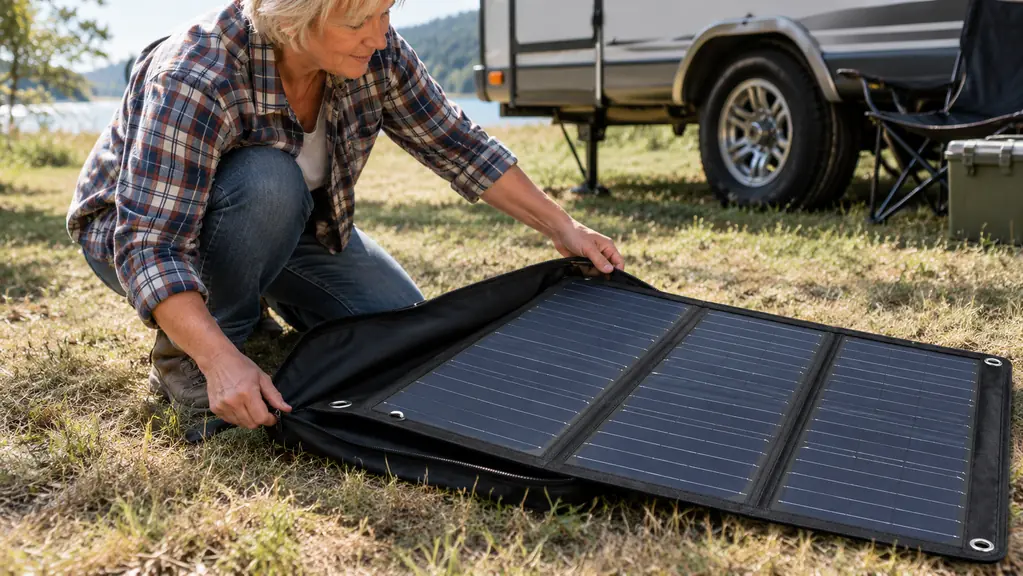
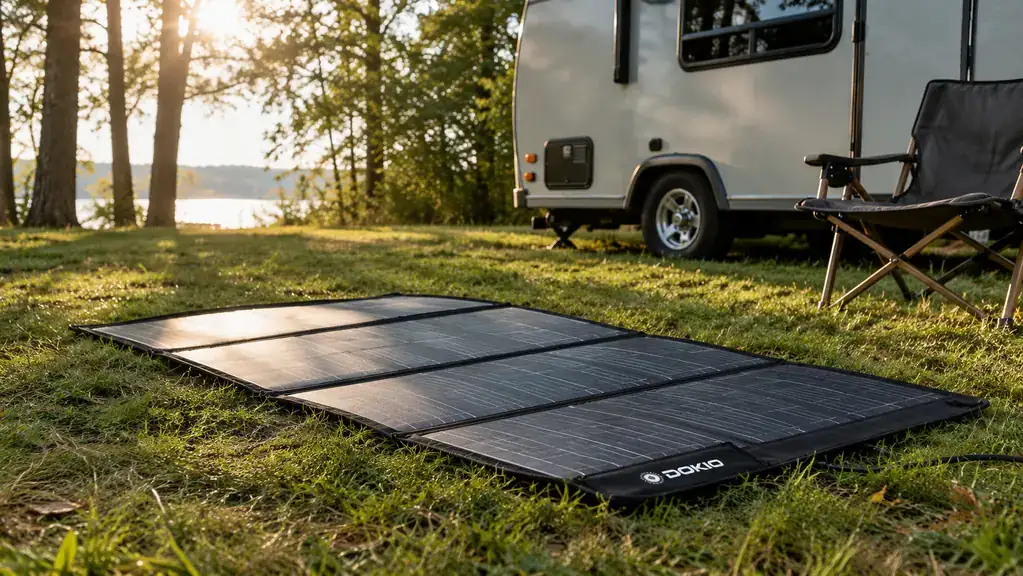
I bought the DOKIO 200W in the spring of my fifth season, after a trip where my old 100W panel kept the fridge at 44 degrees instead of the 38 it needs. The DOKIO now lives in my truck bed between trips. At camp, I unzip the bag, lay the panel flat on the grass in the sun, run the 9.84-foot cable to my power station, and point the panel south. On a good day in full sun, it pushes around 6.1 amps at 12V DC into my batteries. That number matters to me more than the wattage rating, because it is the number that tells me whether the fridge will make it through the night. The first season with the DOKIO, I ran it through my old PWM controller before I trusted the included one, and I learned what good sun looks like by watching the numbers climb. I also learned that a panel lying flat on grass runs cooler than one propped against a tree, which sounds obvious until you have done both.
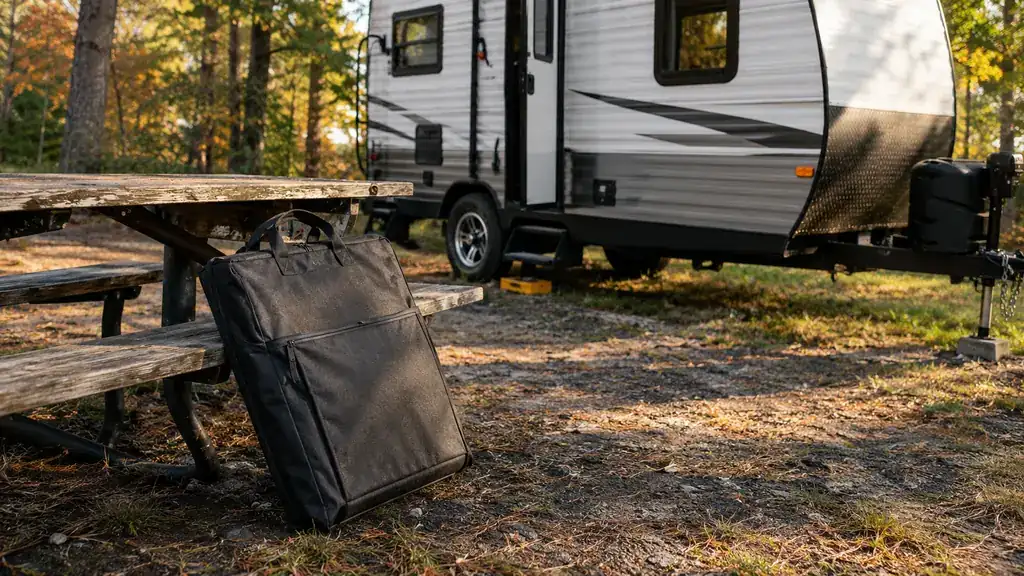
The panel is rated at 200W with a maximum power of 220W, and it folds to 20 by 27 by 1.1 inches. It weighs 9.7 pounds. I am 58 and I can carry it with one hand, which is the whole reason I did not put panels on the roof. My trailer has a roof I do not want to climb on, and I like being able to park in the shade and put the panel in the sun. That is the trade I made, and two seasons later I still think it was the right one.
What It Actually Runs
Let me be specific about what this panel does for me, because wattage ratings on a box mean nothing until you know what they do on a Tuesday. My trailer has a small 12V compressor fridge, a few LED lights, a water pump, and the furnace fan. I also run a small 12V fan for the dogs on warm afternoons. The DOKIO, through its PWM controller, keeps that system charged on most sunny days. In full sun, the fridge runs all day, the fan runs for the dogs, and I wake up to a battery that is full or close to it. On my first trip with the DOKIO, a three-night stay at a state park in June, I parked in the shade, laid the panel in the sun, and never once thought about the battery. That is the whole review in one sentence.
On a partly cloudy day, the panel still does useful work. It does not need to be in direct sun to put something in the battery. It just needs to be pointed at the brightest part of the sky. I have learned to move it twice a day, once in the morning and once in the afternoon, and that habit is worth more than any panel upgrade. The DOKIO's 9.84-foot cable is long enough that I can leave the controller and power station in the shade of the trailer while the panel sits in the sun, which matters on hot days when the controller would otherwise sit in full sun and get warm. I have also learned to watch the sky. When a bank of clouds is rolling in, I fold the panel and put it in the truck, because a loose panel in a gust can take a beating. On one trip in August, a thunderstorm came up fast and I got the panel folded and stowed just before the rain hit. The fridge stayed cold through the storm, and the panel was dry when it was over.
What it does not run: anything that needs 120V AC through an inverter for long. I do not run a microwave, a hair dryer, or a space heater off this panel. I do not think you should try. A 200W panel is a 12V battery charger with a lot of surface area, not a generator. If you want to run big AC loads, you need a bigger system, and no portable panel is going to change that. I cook most meals at camp on propane, and the occasional low-wattage kitchen appliance runs fine off the battery when the panel has had a good day.
The Specs That Matter
The DOKIO 200W is made of monocrystalline silicon, which is the same cell type most good portable panels use. The specs say high efficiency, lightweight, ultra-thin, and foldable, and those are the four words that describe the experience of owning it. The panel folds into a 20 by 27 by 1.1 inch package that fits behind the seat of my truck. It weighs 9.7 pounds, which is light enough that I do not dread hauling it from the truck to the campsite. The maximum voltage is 18 volts, and the output is 12 volts of direct current, which is exactly what my 12V system wants. When I unboxed it, I unfolded it on the living room floor and measured it against the doorway, because a 200W panel that does not fit through the door is a 200W panel I will not use. It cleared the door with room to spare.
The amperage capacity is 6.1 amps, and that is the number I check when I am standing in the sun watching my power station's display. In full sun, I see that number or close to it. The included components are simple: the panel, the bag, and the standalone PWM controller. The controller protects the 12V system against reverse polarity, overcharge, and overload, which matters to me because I have blown up cheaper gear by wiring it wrong. The connector options are SAE to XT60, alligator clips, and DC, so it works with the power station I already owned and with a bare battery if I need it to. I wired the alligator clips to a bare 12V battery once, last September, when a friend's truck battery was dead at a state park. I clipped on, waited twenty minutes in full sun, and the truck turned over. That is the kind of thing you do not plan for, but it is nice to know the panel can do it.
The upper temperature rating is 175 degrees Fahrenheit, which I read as: this panel is not going to melt in a Vermont summer. I have left it lying flat on grass in full sun on 90-degree days and it has never complained. The dimensions when folded, 19.3 by 1.1 by 26.4 inches, are close enough to the marketing's 20 by 27 by 1.1 that I stopped measuring. It fits where I need it to fit, and that is the whole point.
How It Has Held Up Over Two Seasons
I am hard on gear. The DOKIO rides in the truck bed, gets rained on, gets covered in pine needles, and gets folded up while it is still warm from the sun. After two full seasons and part of a third, the panel still works. The zippered bag is the first thing to show wear, and the zipper pull on the main compartment is starting to feel thin. I would not call it a failure, but I would call it the weakest part of the kit. I have started leaving the bag unzipped a few inches when I store it, so the fabric does not stay creased in the same place.
The folding hinges are the part I worried about when I bought it, because a folding panel is only as good as its hinges. Two seasons in, mine are still tight. The panel lays flat on the grass without sagging in the middle, and it folds back up without any binding. I have dropped it once, on a gravel pad, and it took the hit without cracking a cell. I would not recommend dropping yours, but it is reassuring to know the frame is not made of glass. I also learned that the panel does not like being folded while wet. One damp morning I packed it up in a hurry, and by the time I unfolded it two days later, a few spots of mildew had formed along the edge of the bag. A few minutes with a damp cloth and it was gone, but now I let the panel dry in the sun before I fold it. That is the kind of small lesson two seasons teaches you.
The PWM controller is basic. It is not a smart MPPT controller, and it does not pretend to be. It does its job, which is to protect the battery and let the panel charge it. If you already own a power station with a built-in controller, you might not even use the included one. I use mine because my power station accepts the XT60 connector and the controller sits between the panel and the station. It has never given me a problem, and for a piece of gear that lives outside in the weather, that is a compliment.
What I Liked
- Folds to 20 by 27 by 1.1 inches and weighs 9.7 pounds, so it is genuinely easy to carry
- Pushes a real 6.1 amps at 12V DC into my battery in full sun
- 9.84-foot cable lets me keep the controller in the shade while the panel sits in the sun
- PWM controller protects against reverse polarity, overcharge, and overload
- Monocrystalline silicon cells and a 175 degree Fahrenheit upper temperature rating have survived two Vermont seasons
Where It Falls Short
- It is a panel, not a generator: it will not run a microwave or a space heater
- The zippered bag is the first thing to show wear
- You have to move it to follow the sun, or you leave power on the table
- The included PWM controller is basic, not a smart MPPT controller
The number that matters to me is not the 200 in the name. It is the 6.1 amps my battery sees in full sun, because that is the number that tells me whether the fridge will still be cold in the morning.
Who This Is For
This panel is for the camper who wants real power without a roof rack. If you camp in a travel trailer or a van, if you want to park in the shade and put your panel in the sun, if you already own a power station and want to charge it faster, the DOKIO 200W is a strong fit. It is also for the person who is tired of a small panel that barely keeps a phone charged. The jump from 100W to 200W is the jump from trickle to useful, and this panel makes that jump affordable.
It is for the person who does not want to climb on a roof. I am 58, I camp alone with the dogs and the cat, and I have no interest in hauling a ladder and drilling holes in my trailer. A folding panel that I can carry with one hand and lay on the ground is the answer for me. If that sounds like you, you already know why you are reading this. It is also for the boondocker who parks in the trees on purpose. I would rather spend ten minutes moving a panel twice a day than park in a hot open field just to keep the sun. That trade has made my campsites better all season.
Who Should Skip It
Skip it if you need to run big AC appliances. A 200W panel will not run an air conditioner, a microwave, or an electric heater, and no amount of wishing will change that. Skip it if you want a set-and-forget system: this panel needs to be aimed, moved, and folded up when the weather turns. I enjoy that ritual, but it is a ritual, and not everyone wants one.
Skip it if you have a roof you can safely use and you never park in the shade. Fixed roof panels are more convenient, and if you are never going to move your panel anyway, the folding feature is wasted on you. And skip it if you are looking for a smart controller with phone apps and live graphs. The DOKIO's included PWM controller is a plain, dependable piece of equipment, not a smart device. It protects your battery and it charges it, and that is what it does.
Two seasons in, I would buy the DOKIO 200W again without hesitating.
It folds small, it charges hard, and it has never left me with a dead battery. If you are ready to stop babysitting a small panel, this is the upgrade.
Amazon Check Today's Price on Amazon →