The first thing nobody tells you about a folding solar panel is that the wattage printed on the box is a ceiling, not a promise. I learned that on a cold October morning in a Vermont state park, when my house battery was sitting at 11.8 volts and my DOKIO 200W folding panel was lying flat on the grass doing its best in thin autumn light. It took me two seasons, a blown fuse, and one long night with the fridge off to understand what this panel can really do. Now, after three seasons of weekend trips and week-long boondocking stretches, I can tell you exactly where it earns its keep and where it will let you down.
Let me back up. I am Joanne, I am 58, I retired from turning wrenches on school buses, and I have spent the last six years camping with solar in the Northeast. My rig is a 21-foot 2016 travel trailer that my pickup hauls to state parks and a few boondocking spots. I cook most meals at camp, I run a small fridge, and on warm afternoons I run a little 12V fan for the dogs and the cat. That is the whole job: keep the fridge cold, keep the fan spinning, and keep the battery above the line where the furnace will light on a cold night. The DOKIO panel has been my main ground panel for three of those seasons, so this is a long-term review, the kind you only get from using something until the new wears off.
The Quick Verdict
A genuinely portable 200W-class folding panel that keeps a small 12V system fed through a normal camping season, as long as you accept that its PWM controller and real-world output are the honest limits of the design.
Amazon Check Today's Price →The 200W folding panel that earned a permanent spot in my trailer
After three seasons of hauling, folding, and re-angling this panel at campsites across the Northeast, I would buy it again. If you run a small 12V fridge and want off-grid power without cutting holes in your roof, this is the panel I would point you to first.
Amazon Check Today's Price on Amazon →How I've Used It
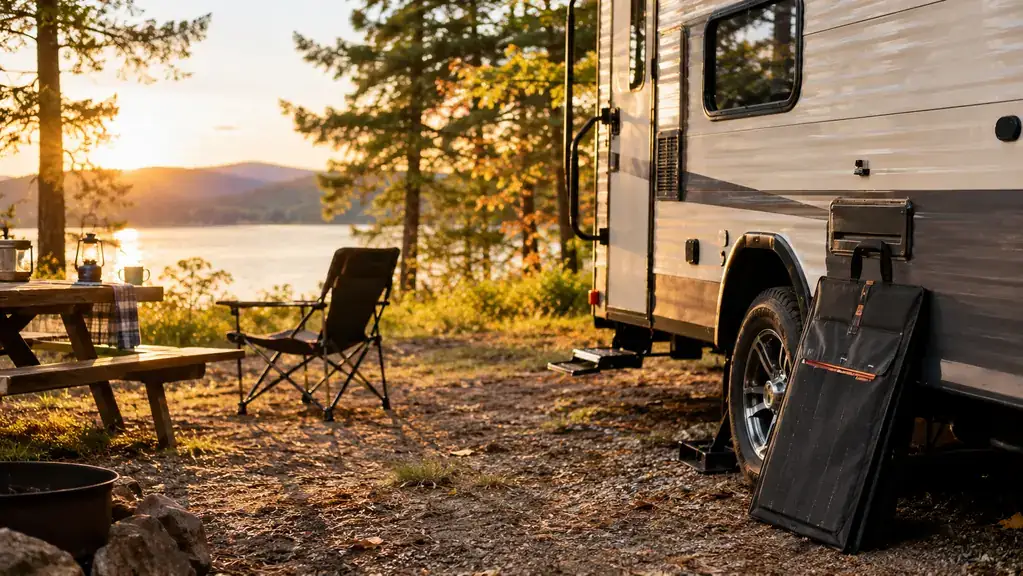
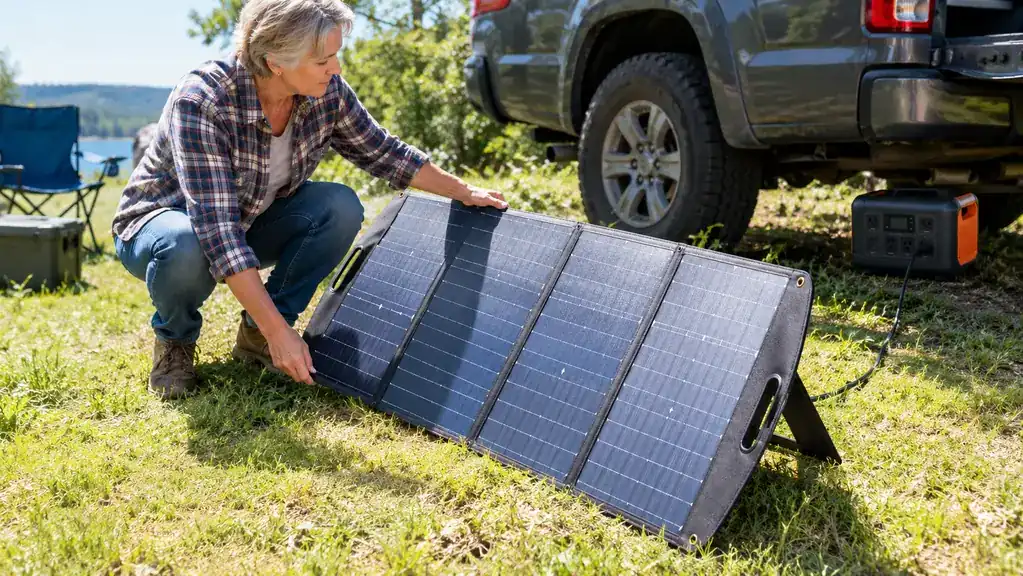
My setup is simple. The panel lives in its included bag behind the trailer's dinette seat. When I park, I pick a spot on the sunny side of the trailer, unfold the panel, and lay it on the grass or prop it against the trailer's own tire to get a better angle. The 9.84-foot cable reaches from the panel to my controller and power station even when the panel is in full sun and the electronics are in the shade, which is exactly how you want it. The whole thing weighs 9.7 pounds, folds to roughly 20 by 27 inches and about an inch thick, and I can carry it in one hand while I hold a coffee in the other.
I connect through the SAE to XT60 adapter when I am charging my portable power station, and I use the alligator clips when I am charging the trailer battery directly. The standalone PWM controller sits in the loop and watches for reverse polarity, overcharge, and overload. I will be honest: I have tripped the overload protection twice, both times my own fault, and both times the controller simply shut things down instead of letting me cook a wire. That is the kind of protection you do not appreciate until you need it.
A normal day for me is coffee on the propane stove, breakfast, then a walk while the panel does its morning work. By early afternoon the fridge has cycled a few times, the fan has been on for the dogs, and the battery is back to full. I fold the panel up before the evening bugs arrive and lean it against the picnic table. That rhythm has carried me through three seasons.
My first season with solar was a disaster of my own making. I started with a single small panel and a portable power station, and I treated the panel like a magic mat: lay it flat, plug it in, walk away. By the second night the power station was dead, the fridge was warm, and I was reading the manual by headlamp. The problem was not the gear. The problem was that I expected the panel to do all the thinking. With the DOKIO panel I made myself learn the routine: face it south, tilt it toward the sun, move it when the shade creeps across the campsite, and check the controller once in a while. That routine is the difference between a panel that feeds you and a panel that just lies there. Nobody tells you that the panel is only half the system. The other half is you.
What the Spec Sheet Gets Right
The DOKIO panel is built around monocrystalline silicon cells, and the listed numbers are mostly the ones that matter. Maximum power is rated at 220 watts on the spec sheet, the panel is sold as a 200W panel, and it puts out 18 volts at up to 6.1 amps into a 12-volt system. Those are the numbers I check when I compare panels, and they line up with what I actually see on my controller on a clear day.
The weight and the folded size are the real story. At 9.7 pounds with a bag included, this is a panel you will actually carry to the sunny spot instead of leaving it in the truck because it is too heavy to bother with. I have set it up on grass, on gravel, on a picnic table, and once on the hood of the pickup when the campsite was all shade. Portable means portable.
The temperature rating is another spec people skip. The panel is rated up to 175 degrees Fahrenheit, which matters more than you would think. Panels sitting flat on dark grass on a July afternoon get genuinely hot, and a panel that loses output in heat stops earning its keep right when the sun is strongest. I have never seen this one complain.
What Nobody Tells You About a 200W Rating
Here is the honest part, and it is the part I wish someone had explained to me before my first season. A 200W panel rarely delivers 200 watts. The rating is measured in a laboratory with the sun dead overhead and the panel perfectly square to it. In the real world you get a fraction of that: morning and evening sun comes in at an angle, clouds roll through, trees throw shadows, and the whole output slides.
My rule of thumb after three seasons is to plan on about half the rated wattage over the course of a normal sunny day, and less when the sky is hazy. That sounds like a complaint, but it is not. It is the difference between buying a panel and understanding a panel. Once I stopped expecting 200 watts and started expecting a steady 80 to 120 watts of usable charging through the good part of the day, the DOKIO panel started looking like exactly what it is: a dependable tool that matches its class.
The other thing nobody tells you is that the controller matters as much as the panel. This kit uses a PWM controller, which is the simpler and cheaper type. An MPPT controller can squeeze more out of the same panel, especially in partial sun, but it also costs more. For my small 12V system the PWM controller has been fine. If you are running a bigger battery bank and want every watt, you may want to budget for an MPPT controller separately. That is not a flaw in the panel. It is just the honest shape of the deal.
Three Seasons of Weather and Wear
I have used this panel in sun, in wind, in a surprise thunderstorm that sent everyone scrambling, and in enough buggy Vermont evenings to test my patience. The panel itself has held up. The monocrystalline cells sit protected under the surface, the folding joints still move smoothly, and the bag has kept the panel from getting knocked around in the trailer. I do not treat it gently, and it has not complained.
The cable is the part I watch. Nine point eight four feet is long enough for most campsites, but I have learned to coil it loosely and keep it out of walkways. The alligator clips are strong, and the SAE and XT60 connections are the standard ones, which matters more than it sounds. When a connector is standard, you can replace a cable or add an adapter without replacing the whole kit.
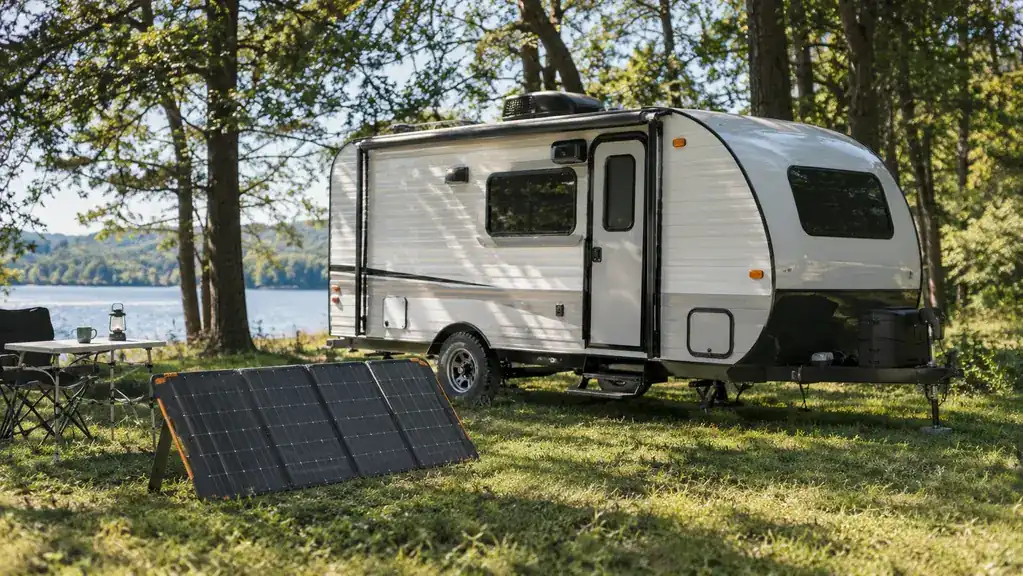
One small honesty: the panel has no built-in stand. The specs do not claim one, and the design assumes you will prop it or lay it flat. I prop mine against the trailer tire or a camp chair, and I adjust the angle by moving whatever it leans on. It works, but if you want a panel with a kickstand, this is not that panel. Read the listing the way I wish I had: what you get is the panel, the bag, the cable, and the controller.
On a clear July afternoon, this 9.7-pound panel kept my fridge running and my battery above 12.4 volts from breakfast until the sun went behind the ridge.
The Numbers I Actually Track
When I am camped, I check three numbers: voltage, amps, and how full the battery is when the sun goes down. The DOKIO panel's spec sheet lists 18 volts maximum and 6.1 amps into a 12-volt system, and those are the readings I have learned to watch on my controller. Voltage tells me the panel is alive. Amps tell me how hard it is working. And the battery level at dusk tells me whether tomorrow will be an easy day or a careful one.
The 12-volt DC output is the detail that matters most for my rig. Everything I run, the fridge, the fan, the lights, the water pump, is 12-volt. I do not need an inverter for most of my camping life, which means I do not lose power converting DC to AC. A panel that speaks 12-volt natively is a panel that talks to my trailer in its own language.
What I'd Change
If you want the honest review, here is my list. I would like a slightly longer cable, because a 9.84-foot cable means the controller has to sit fairly close to the panel, and sometimes the shade and the sun are farther apart than that. I would like a built-in angle stand, for the reason I just gave. And I would like more feedback from the controller, since I often end up walking over to my power station to check its readout instead.
None of those are dealbreakers. They are the difference between a panel that is perfect and a panel that is very good for what it is. I have camped three seasons with this one, and the only time I was truly stuck was the first season, when I did not understand how much sun angle matters and let the panel sit flat all day. That was my error, not the panel's.
What I Liked
- Genuinely portable: 9.7 pounds, folds to about 20 by 27 inches, and comes with a bag
- Monocrystalline cells and a 220-watt maximum rating that line up with real-world output on clear days
- The 9.84-foot cable is long enough to keep the controller in the shade while the panel works in full sun
- The PWM controller's reverse polarity, overcharge, and overload protection has saved me from myself twice
- Standard SAE, XT60, and alligator clip connections mean easy replacements and adapters
Where It Falls Short
- The PWM controller leaves some power on the table compared to an MPPT setup
- No built-in stand, so you will be propping the panel against things
- Real-world output is roughly half the rating on an average day, which takes getting used to
- The 9.84-foot cable can feel short when the only sunny spot is far from the battery
Who This Is For
Buy the DOKIO 200W folding panel if you camp like I do: a small 12V fridge, a fan on warm afternoons, a few lights, and a battery that needs to be topped up every day. It is for people who want power without a roof install, who camp where the trees are not too tall, and who are willing to move the panel a couple of times a day to chase the sun. It is for the person who wants a panel that fits behind the dinette seat and comes out to do a job.
It is also for the person who wants to learn solar without betting the whole trailer on it. It is an approachable way into off-grid power, the connections are standard, and the protection on the controller means a beginner can make a mistake without setting anything on fire. I made mistakes with mine. The panel forgave me.
Who Should Skip It
Skip it if you need to run a large battery bank, an inverter pushing serious wattage, or a full-time residential fridge. A single 200W-class panel is a maintenance tool for a small system, not a power plant. Skip it if your campsites are deep in the trees, because a folding panel needs open sky to earn its keep. And skip it if you want a roof-mounted, walk-away-and-forget solution, because this panel wants attention: you will angle it, move it, and fold it up every day.
If your needs are bigger than this panel, look at a roof array or a second panel wired in. If your needs are smaller, the same DOKIO family makes smaller panels that are easier to haul. The honest advice is to match the panel to the job, and the honest truth about this one is that its job is steady, modest, off-grid living for one trailer.
I looked at a rigid roof panel before I settled on this one, and I will admit the appeal: set it once, forget it, and let it charge every day the sun is out. But my trailer is 21 feet, I park in the shade as often as I can find it, and I did not want to drill holes in a roof that has already been through a few Vermont winters. I also looked at bigger and smaller folding panels. Bigger means more watts, but also more weight and a bigger folded footprint, and my storage spot behind the dinette seat is not generous. Smaller means easier to haul, but not enough output to run the fridge through a warm stretch. The 200W class is the balance point for my setup, and yours may be different. Match the panel to the job.
Three seasons in, this is the panel I would buy again
The DOKIO 200W folding panel has earned its spot in my trailer. If you are shopping for a portable panel to feed a small 12V system, check today's price on Amazon and read the listing with fresh eyes: what is included, what it weighs, and what it will really do on an average day.
Amazon Check Today's Price on Amazon →