

I killed my first house battery on a Tuesday night in October. Nothing dramatic: I ran the furnace fan too long, drained the old lead-acid battery flat, and then let it sit that way until spring. By May it would not hold a charge worth talking about, and I spent the next season running the truck engine to keep the trailer lights on. That is how a retired school bus mechanic with a 21-foot travel trailer ended up reading about lithium batteries at the kitchen table with a cold cup of coffee. The Litime 12V 100Ah Group 31 LiFePO4 is the one I finally ordered, and after three seasons of real use, I have honest thoughts.
Here is what I want you to know before you read another word: this is not a perfect battery, and I am not going to pretend it is. It is a very good 12V 100Ah lithium battery for a travel trailer, and it has a few quirks the product page does not exactly advertise. I would buy it again. I just think you should buy it with your eyes open, the way I wish I had the first time around.
The Quick Verdict
A genuinely good drop-in lithium replacement for a travel trailer, with honest limits: no Bluetooth, M8 terminals that need the right connectors, and a cost that only makes sense if you plan to keep your rig for years.
Amazon Check Today's Price →The battery I would buy again for my 21-footer
After three seasons of boondocking, the Litime 12V 100Ah LiFePO4 has earned its spot in my trailer. It is light enough to lift with one hand, the built-in 100A BMS watches the charging for me, and the 5-year warranty covers the big what-ifs.
Amazon Check Today's Price on Amazon →How I've Used It
Before I tell you what I like, let me tell you what I actually do with this battery, because the answer changes what you should buy. My rig is a 2016 travel trailer, 21 feet, towed by a pickup truck. I camp from late spring to mid fall, mostly in state parks and boondocking spots around the Northeast. Two dogs and a cat travel with me, and on warm afternoons I run a small 12V fan for them. That steady, boring draw is exactly what used to worry me with lead-acid.
On a typical trip I run a small fridge, LED lights, the fan, and whatever low-wattage kitchen appliance I am brave enough to plug in. I cook most meals at camp. That is the honest load: not a coffee maker and a microwave at the same time, but a fridge that stays cold overnight and lights that stay bright on the third cloudy day. With the old battery I treated power like a ration. With this one I still pay attention, but the math changed.
The best way I can describe it is this: I used to plan my evenings around the battery gauge. Now I plan meals around what I feel like cooking. The fridge runs all night, the fan runs in the afternoon, and I wake up to a battery that still has room to spare. That is the real difference, and it is not a small one.
One thing I did not expect: how much the dogs' comfort changed. On warm afternoons I run that little fan for them while I am outside reading or tightening something on the trailer. With the old battery I felt guilty about the fan. Now I do not think twice. It is a small thing, but it is the difference between a battery you manage and a battery that just works.
The First Thing Nobody Tells You: Usable Capacity
Here is the part that took me a while to understand, so I will say it slowly. A lead-acid battery does not like being drained past about half. Do it often and you shorten its life. That means a 100Ah lead-acid battery really gives you about half of its rated capacity before you start hurting it. A LiFePO4 battery like this one is built to discharge much deeper, and the built-in 100A BMS is what watches the over-discharge side of that equation.
So the same 100 amp hours on paper gives me meaningfully more usable power on a cloudy weekend. I do not have to do anything special to get it. I connect things the same way I always did, and the battery simply has more to give before it asks me to slow down. For someone who camps off the grid in the Northeast, where a sunny stretch is never guaranteed, that margin is the whole ballgame.
I want to be careful here, because I am not an engineer and I do not want to oversell. The battery is rated for 100 amp hours, and the listing is honest about the 15,000-plus cycle life and the 10-plus year design life. What I am describing is my experience of usable power, not a lab test. But the experience is consistent: I get more evenings of lights and fridge out of this battery than I ever got out of the lead-acid one, and I do not treat it gently.
What the BMS Does and Does Not Do
The product page talks about the built-in 100A BMS, and it is worth understanding what that actually means. It protects against overcharge, over-discharge, and short circuits. I have tested the over-discharge protection once, on purpose, and it did exactly what it was supposed to: it shut things down instead of letting the battery hurt itself. That is a real feature, and I am glad it is there.
But here is what nobody tells you: a BMS is not a babysitter. You still need to charge this battery with a charger that understands lithium, and you still need to respect cold weather. Lithium batteries do not like being charged below freezing. I do not have a heated battery box, so I simply do not try to charge this battery when it is frozen. On cold nights it comes inside the trailer, or charging waits until morning. That is a habit, not a feature, and you should know that going in.
There is a difference between protection and permission. The BMS protects the battery from the big mistakes, the ones that would have killed my old battery in a single night. It does not tell you how much power you have left, and it does not make decisions for you. You still decide when to run the fan and when to turn things off. I happen to like that. I would rather be the one in charge.
Lifting It, Fitting It, Wiring It
Here is a number that surprised me: 22.1 pounds. The lead-acid battery I took out of my trailer weighed about three times that. Lifting this one into place with one hand honestly changed how I felt about the whole job. The 22.05 pounds the listing mentions is accurate. For someone my age, that difference matters every single time you pull the battery for winter.
The size is Group 31, and the dimensions are printed on the listing for a reason: 13 inches wide, 8.5 inches high, and 6.77 inches deep. Measure your battery box before you order. I did, and mine fit, but a neighbor at a state park in Vermont bought one without measuring and spent an afternoon making it fit. That is a thirty-minute job with a tape measure and a notepad.
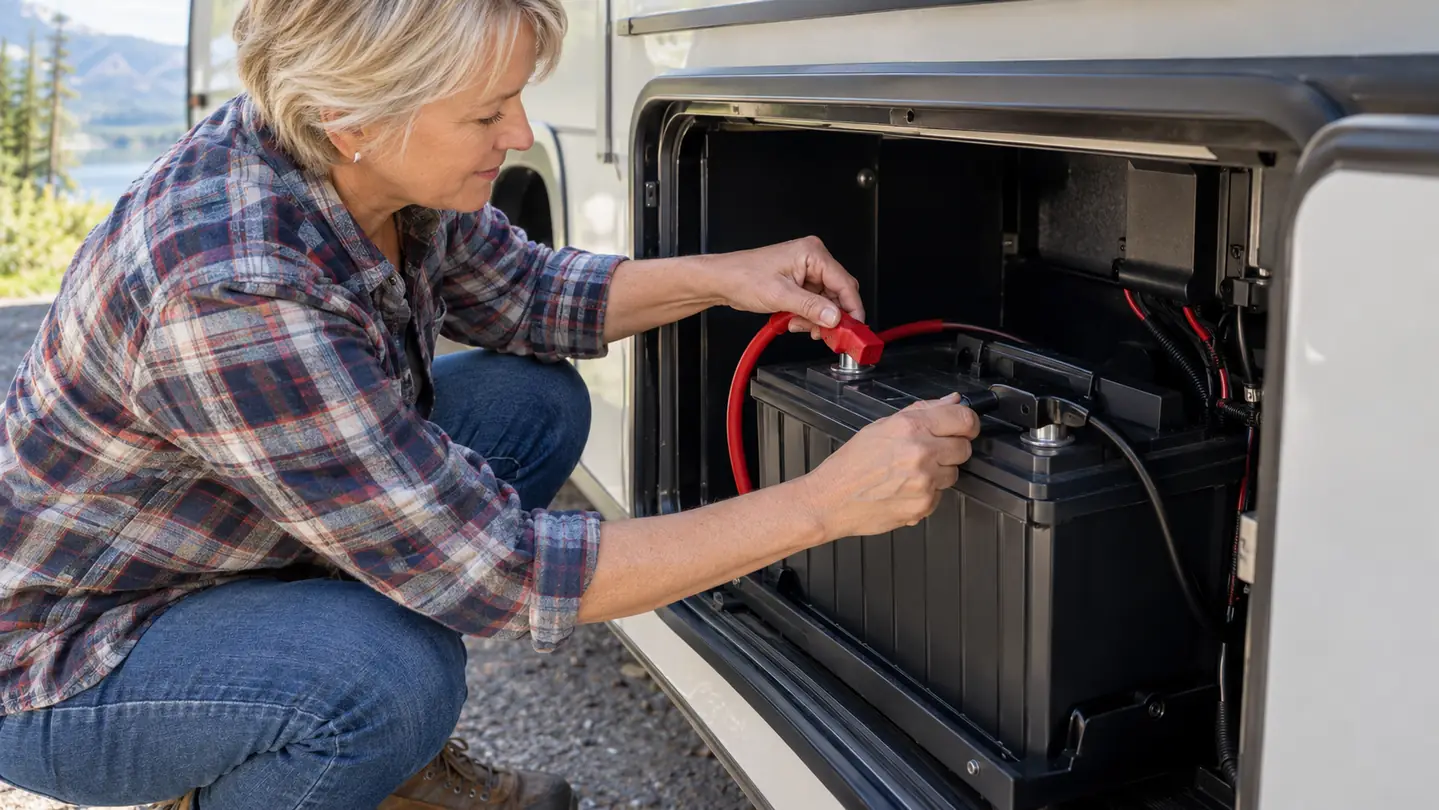
The terminals are M8, which means you need the right ring terminals or lugs and the right wrench. It is not hard, but it is the kind of detail you will miss until you are crouched in a trailer compartment holding a flashlight. Buy the connectors at the same time you buy the battery, and you will save yourself a second trip to town.
The weight matters for another reason too: I pull this battery out of the trailer every fall and put it back every spring. With the old battery that was a two-person job and a backache. With this one I carry it like a heavy toolbox. If you are the person who does the maintenance in your camping household, you will understand exactly why that is on my list of favorite things.

Charging It the Right Way
I mentioned that a lithium battery needs a charger that understands lithium, and I want to be specific about what that meant for me. My trailer runs on a solar setup that I have added to over the years, and the charge controller was the first thing I checked before I installed this battery. If your trailer has an older converter, read the manual before you connect a LiFePO4 battery. Some chargers treat all 12V batteries the same, and that is not what this battery wants.
The good news is that the switch was easier than I expected. Once I confirmed the charger was compatible, installation was the same as any battery: put it in the box, connect the terminals, and let the BMS do its job. I do not think about charging the way I used to. On sunny days the solar brings it back up, and on cloudy days I plan a little better. That is the whole routine.
One more thing about cold weather, because the Northeast does not mess around. I said earlier that I do not charge below freezing, and I want to be honest about what that looks like on a trip. It means checking the forecast, moving the battery inside on the coldest nights, and accepting that some mornings the power comes on later than I would like. It is a small trade for a battery that otherwise runs all season without complaint.
The same 100 amp hours on paper gives me more usable power on a cloudy weekend than my old lead-acid battery ever did.
The Quirks Nobody Mentions
Now the honest part. There are three things I want you to know that the product page will not tell you. The first is that this is the no-Bluetooth version. The listing says so, but it is easy to skim past. There is no app, no phone connection, no checking your state of charge from the camp chair. You check it with a multimeter or with a monitor you add yourself. I made peace with this because I am a look-at-the-voltage kind of person anyway. But if you want a battery you can talk to from your phone, this is not the one.
And here is a twist I did not expect: the no-Bluetooth version is part of why I trust it. There is less to go wrong, nothing to pair, nothing to update, no app that stops working when the company changes servers. Some people will see the missing app as a dealbreaker. I see it as one less thing to troubleshoot at camp.
Second, the 5-year warranty and the 24-hour tech support are part of the deal, and I have not needed to use either, which is the best thing I can say about any battery. Knowing they are there if something goes wrong is part of why I sleep fine with this battery under the trailer floor.
Third, and this is the one almost nobody says out loud: a lithium battery only pays for itself if you actually keep it. The long service life, the 15,000-plus cycles, the 10-plus year design life, none of it matters if you sell the trailer next spring. If you are the kind of person who keeps a rig for years, this battery is an easy choice. If you trade trailers every couple of seasons, you are paying for longevity you will never use.
What I Liked
- Weighs 22.1 pounds, about a third of the lead-acid battery it replaced, and I can lift it with one hand
- Built-in 100A BMS watches overcharge, over-discharge, and short circuits
- Usable capacity is meaningfully higher than a lead-acid battery with the same 100Ah rating
- 5-year warranty and 24-hour tech support from Litime
- No maintenance, no checking water levels, no corrosion worries
Where It Falls Short
- No Bluetooth version, so no app and no phone-based state of charge
- M8 terminals need the right connectors and the right wrench, easy to forget until install day
- Group 31 case means measuring your battery box before you order
- Cold weather charging is managed by you, not by the battery
Who This Is For
This battery is for the camper who stays at camp. If you run a fridge overnight, if you cook at the trailer, if you want lights that do not dim when the clouds roll in, and if you plan to keep your rig for years, the Litime 12V 100Ah is a genuinely good fit. It is also for anyone who has ever lifted a lead-acid battery and would rather not do it again. At 22.1 pounds, this is the easiest part of my setup to move.
I will add one more thing. If you are new to camping with solar, the way I was six years ago, this battery will not fix a setup that is too small for what you run. It is a storage tank, not a generator. But if your panels and your habits are already in the right place, a battery like this is the upgrade that makes the whole system feel effortless.
Who Should Skip It
Skip it if you want to check your battery from your phone, because this is the no-Bluetooth version and an app is not coming. Skip it if you have a small battery box and are not willing to measure it first. And honestly, skip it if you are planning to sell the trailer in a year or two. The long service life is the whole point, and you would be paying for years you will not use.
Also skip it if you camp with shore power every single night and never boondock. A battery this capable is wasted on a site with a hookup. And if you do not want to think about cold weather charging or read a charger manual, a lead-acid battery may honestly be less fuss for your life. There is no shame in that. Buy the tool that fits the job.
I will end where I started. I blew up a battery by not understanding it, and I bought this one after a lot of reading and a little luck. Three seasons in, I would make the same choice again. Not because it is perfect, but because it is honest: it does what it says, it weighs what it says, and its limits are ones I can live with. That is all I ask of any piece of gear.
Ready to stop rationing power at camp?
The Litime 12V 100Ah LiFePO4 has run my fridge, my lights, and the dogs' fan for three seasons without a complaint. If that sounds like your kind of upgrade, check the current price on Amazon and measure your battery box while you are at it.
Amazon Check Today's Price on Amazon →