
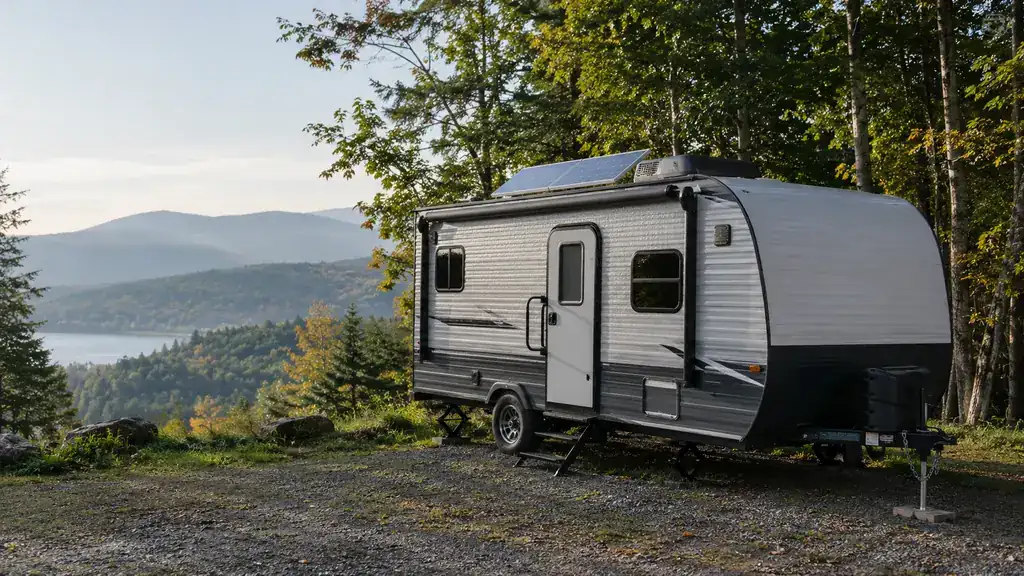
The first night I ever spent fully off-grid, my old lead-acid house battery died at 2 a.m. The furnace blower slowed, the lights went dim, and I sat in the dark with two dogs and a cat wondering what I had done wrong. Six years later, I have worked through that same setup, blown more fuses than I care to count, and read enough battery manuals to fill a shelf. When I finally swapped in a Litime 12V 100Ah LiFePO4 battery, the change was not subtle. It was the difference between babysitting my power and forgetting it existed.
I am Joanne, a retired school bus mechanic who camps from late spring to mid fall in a 2016 travel trailer, 21 feet, towed by my pickup. I cook most meals at camp, run a small fridge, and keep a little 12V fan going for the dogs on warm afternoons. This review is about what the Litime battery has done across a full season of that life, not just a weekend.
The Quick Verdict
The Litime 12V 100Ah LiFePO4 battery has run my trailer's fridge, lights, furnace blower, and fan for a full season without a single voltage drop that mattered. It is not the cheapest battery on the market, but it has been the most reliable piece of my power setup.
Amazon Check Today's Price →Want a house battery that just works?
I have used the Litime 12V 100Ah LiFePO4 battery for a full camping season and it has not let me down once. Check today's price on Amazon and see if it fits your rig.
Amazon Check Today's Price on Amazon →How I've Used It
My trailer runs on 12V for the basics: the water pump, the furnace blower, the fridge controls, the interior lights, and the little fan I switch on for the dogs. Before the Litime battery, I was running a single lead-acid group 24 that weighed about 50 pounds and held maybe half its rated capacity by the second year. I sized my solar around that battery, which meant I was always planning my power use around a battery that was slowly lying to me.
I installed the Litime battery in the same compartment the old one came out of. It is a Group 31 size, which means it drops into the same footprint as a standard larger lead-acid battery, but at 22.1 pounds it weighs about a third of what I was lifting before. That matters more than you think when you are hauling a battery in and out of a trailer at the start and end of every season.
The day I swapped it in was a Saturday in late May, the first trip of the season. I pulled the old battery, cleaned the corrosion off the tray with a wire brush, and set the new one in place. The M8 terminals lined up with my cables without an adapter, which surprised me because I had expected to fight the fit. The dimensions, 6.77 inches deep, 13 inches wide, and 8.5 inches tall, are bigger than the group 24 I pulled out, but my compartment had room to spare and the box closed over it fine. What I did not expect was how much easier the wiring was. The old battery had terminals that had corroded twice, and I had replaced one cable end at a gas station with a pair of pliers. The Litime battery went in clean in about twenty minutes, and I spent the rest of the afternoon double-checking my work because it felt too easy.
My setup is simple: one 100W solar panel on the roof feeding a basic PWM controller, plus a tow vehicle charge line when I drive. I am not running an inverter full time. I use 12V appliances for almost everything, and I keep the occasional low-wattage kitchen appliance on a small inverter that I plug in only when I need it. The Litime battery has handled that pattern easily.
This is the battery I reach for every season
After a full season of running my fridge, furnace, lights, and fan, the Litime 12V 100Ah LiFePO4 battery is the one I trust. See what it costs today on Amazon.
Amazon Check Today's Price on Amazon →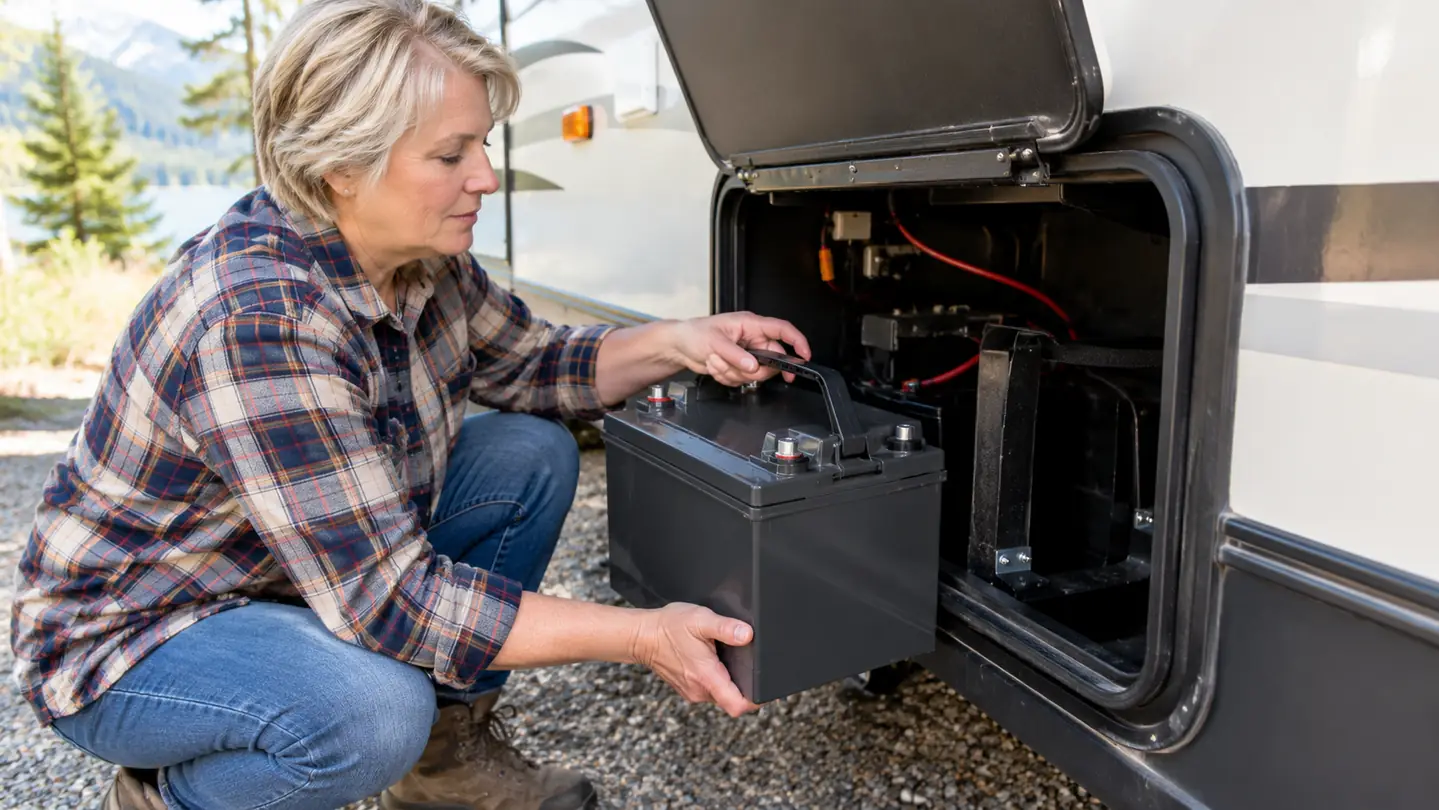
What the 100Ah Rating Actually Means for a Camper
A 100 amp hour battery sounds like a lot until you are the one counting amps. My fridge draws a few amps when the compressor runs, the furnace blower pulls more on a cold night, and the water pump takes a quick hit every time someone turns on a faucet. The honest way to think about 100Ah is that it gives me a comfortable buffer: I can run my normal loads through an evening, wake up to a battery still above 12 volts, and let the solar panel refill it during the day.
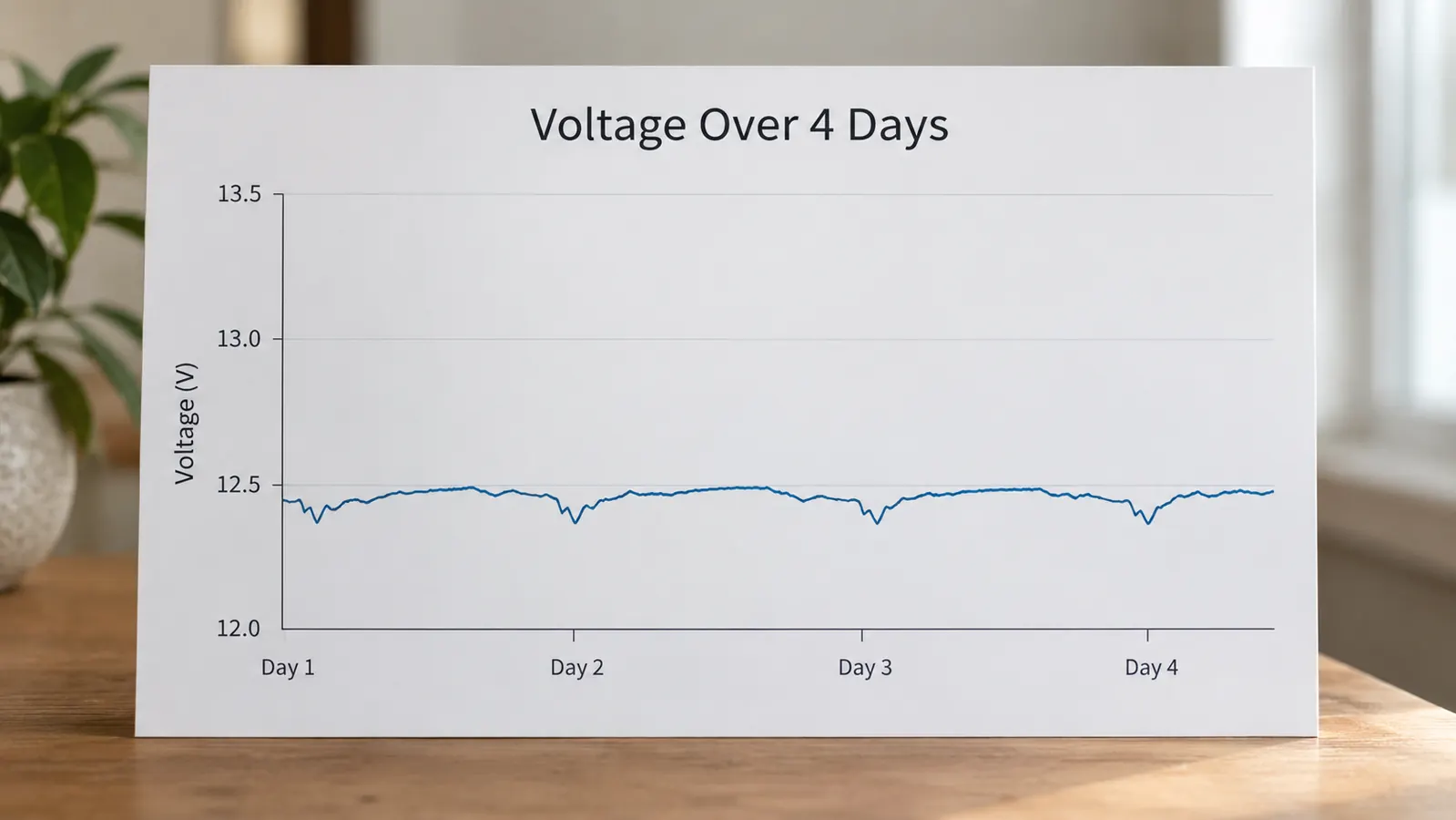
Let me give you one real evening so the numbers mean something. On a July night at a state park with no hookups, I ran the fridge, the interior lights for about three hours, the water pump for the usual dishes and showers, and the little fan for the dogs on a warm evening. When I checked the battery monitor before bed, it sat around 12.4 volts. By morning, after the fridge cycled all night, it read 12.2. That is a comfortable place to be. My old lead-acid battery would have started that same night near 12.4 and woken me at 5 a.m. with the furnace blower dragging. The difference is not the rating on the label. It is how much of the rating you are actually allowed to use. LiFePO4 delivers the full 100 amp hours, while a lead-acid battery only lets you safely use about half. That is the real reason a 100Ah lithium battery feels like twice the capacity.
The Litime battery is rated for 12 volts and 100 amp hours, and the built-in 100A BMS is what protects it from the two things that killed my old batteries: over-discharge and over-charge. I have accidentally run it lower than I meant to, and the BMS simply shut things down instead of letting the battery get damaged. That protection is the reason I stopped worrying about whether I left a light on.
One number that matters to me more than the amp hours is the cycle life. The specs say 15,000+ cycles and a 10+ year life, which is roughly ten times what I got out of lead-acid. I cannot test 15,000 cycles in one season, but I can tell you the battery has not shown a single sign of the capacity fade I saw in my old battery after one winter of storage.
How It Held Up Over a Full Season
I installed the Litime battery in late spring, and it has now been through a full season of weekend trips, a two-week trip to the Northeast Kingdom, and several nights of boondocking in state parks with no hookups. The pattern has been consistent: the solar panel tops it off during the day, the fridge and fan pull it down overnight, and I wake up to a battery that is still where I left it.
The trip that told me the most was two weeks in the Northeast Kingdom in August. We had three days of rain in the middle, and my single 100W panel spent most of that time putting out almost nothing. The fridge and the fan still ran every day, and the battery just kept going. It dropped lower than I liked by the third cloudy morning, down around 12.1 volts, but it never quit, and the first sunny afternoon brought it right back to full. With my old battery, that same stretch would have meant shutting the fridge off at night and rationing the fan. I did not change a single habit. I also left the trailer sitting for three weeks in September with the battery connected and nothing on the charger, and it started the season's last trip without a fuss. A lead-acid battery would have been flat by then.
The coldest night I spent with it was right around freezing. My furnace blower ran more than usual, and the battery handled it without the dramatic voltage sag I used to see with lead-acid. LiFePO4 chemistry does not like being charged below freezing, and my setup does not have a low-temperature cutoff, so I simply do not charge it on nights that cold. That is a real limitation, and I will come back to it.
The weight difference showed up the first time I pulled the battery out at the end of the season. At 22.1 pounds, I could carry it with one hand. My old battery took both hands and a grunt. For a solo camper, that is not a small thing.
The first night I ever spent fully off-grid, my old battery died at 2 a.m. The Litime battery has never once left me in the dark.
What It Runs and What It Does Not
Here is exactly what the Litime battery runs in my trailer: the water pump, the furnace blower, the fridge, the interior lights, the little 12V fan for the dogs, and a USB charger for my phone. That list covers everything I actually need when I am boondocking. I also use it to jump-start my day by running a low-wattage kitchen appliance through a small inverter for a few minutes at a time, and it handles that without complaint.
I learned the limit the honest way, on a chilly morning in October when I wanted coffee and my small inverter was already busy with a kettle. I plugged in a second appliance without thinking, and the inverter beeped and shut down. The battery itself did not care. The BMS held everything steady, the inverter reset, and I made my coffee one appliance at a time. That is the behavior I have come to trust. It does not silently brown out like my old battery did. It either has the power or it tells you, through the inverter, that it does not. The other thing I have learned to appreciate is the fan on warm afternoons. The dogs get hot in the trailer, and I run that little fan for hours at a stretch without thinking about the amp draw. With lead-acid, I would have turned it off before the dogs were cool, just to protect the battery. Now I leave it running.
What it does not do is run a big inverter load like a microwave or a space heater for any length of time. That is not a failure of the battery. It is physics. A 100Ah battery at 12 volts stores about 1.2 kilowatt hours of energy, and a space heater would drain that in about an hour. If you are planning to run heavy AC loads, you need a larger battery bank, not a different brand.
The other thing it does not do is talk to my phone. This is the non-Bluetooth version of the Litime battery, which is exactly what the specs say: no Bluetooth version, ideal for RV, marine, trolling motor, boat, travel trailer, and home energy use. Some people want an app that shows them state of charge. I have never missed it, because my battery monitor and my solar controller tell me what I need to know.
Who This Is For
The Litime 12V 100Ah LiFePO4 battery is for the camper who wants to stop thinking about their battery. If you run a small fridge, lights, a water pump, and a fan, and you want to wake up to power without calculating every amp, this battery is a direct fit. It is also for the solo camper who is tired of lifting 50 pounds of lead-acid in and out of a trailer, because at 22.1 pounds, this one is genuinely easy to handle.
It is also for anyone who already has a basic solar setup and wants a battery that can actually use it. My single 100W panel is enough to keep this battery topped off for my loads, which was never true with my old lead-acid battery. If you are tired of your battery being the weak link, this is the upgrade.
Who Should Skip It
Skip the Litime battery if you need to run heavy inverter loads. A microwave, a space heater, or a coffee maker that draws 1,000 watts or more will drain a single 100Ah battery fast, and you will be disappointed. You want a larger battery bank or a generator for those loads, not a single 100Ah battery.
Skip it if you camp in deep winter and charge from solar in freezing temperatures. LiFePO4 batteries do not like being charged below freezing, and this version does not have a low-temperature cutoff. I manage around it by not charging on the coldest nights, but if you camp in serious cold, you need a battery with cold-weather charging protection or a heated option.
And skip it if you want an app on your phone. This is the non-Bluetooth version, so there is no app, no wireless monitoring, and no way to check state of charge from your phone. If that matters to you, look for the Bluetooth version of the same battery.
What I Liked
- Built-in 100A BMS protects against overcharge and over-discharge
- Weighs 22.1 pounds, about a third of a comparable lead-acid battery
- Rated for 15,000+ cycles and a 10+ year life
- 5-year warranty with 24-hour tech support
- Group 31 size drops into a standard battery compartment
- Held up through a full season of my normal camping loads
Where It Falls Short
- No Bluetooth version, so no phone app or wireless monitoring
- No low-temperature charging cutoff on this version
- 100Ah is not enough for heavy inverter loads like space heaters
The Bottom Line
I have spent six years learning solar the hard way, and the Litime 12V 100Ah LiFePO4 battery is the first battery that has made me stop paying attention to it. It runs everything I need, it weighs less than half of what I used to haul around, and it has a 5-year warranty backing it up. I would buy it again tomorrow.
Ready to stop babysitting your battery?
The Litime 12V 100Ah LiFePO4 battery has earned its place in my trailer for a full season. Check today's price on Amazon and see if it is the upgrade your rig needs.
Amazon Check Today's Price on Amazon →