
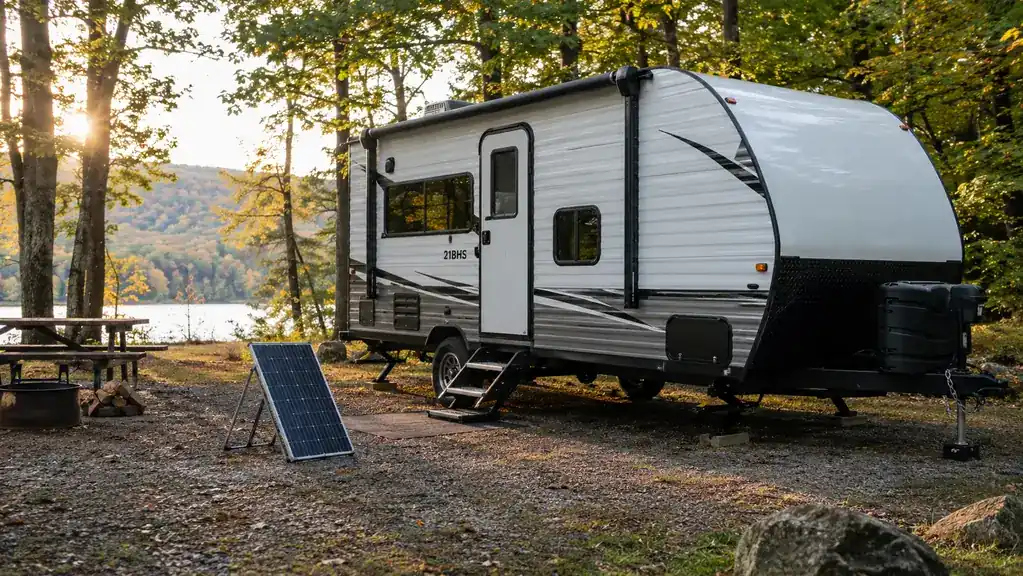
If you camp off-grid the way I do, the choice between a Litime 12V 100Ah LiFePO4 battery and an AGM deep cycle battery comes down to one question: do you want to haul a battery that lasts a decade, or save money upfront and replace it every few seasons? I have run both in my 2016 travel trailer, and after six years of camping with solar, I would not go back to AGM for my own rig.
That is not the same as saying AGM is a bad battery. It is a fine battery for some setups. But for a camper who cooks most meals at camp, runs a small 12V fan for the dogs on warm afternoons, and wants the fridge to stay cold through a cloudy weekend, the Litime battery wins on almost every point that matters to me. Here is the honest comparison, including where AGM still makes sense.
| Litime 12V 100Ah LiFePO4 | AGM Deep Cycle Battery | |
|---|---|---|
| Upfront cost | Higher purchase price, but it is a buy-once part of the system | Lower purchase price, which matters on a tight build budget |
| Cost over 10 years | Built for 10+ years and up to 15,000+ cycles, so the math leans Litime over time | A few hundred deep cycles before capacity fades, so you budget for replacements |
| Weight | 22.1 pounds, about a third of a comparable lead-acid battery | Usually two to three times heavier for the same rated capacity |
| Usable capacity | Rated 100 amp hours with a built-in 100A BMS guarding overcharge, over-discharge and shorts | Rated 100 amp hours, but you get the best life by stopping at about half discharge |
| Cycle life | Up to 15,000+ cycles and a 10+ year design life | Typically several hundred cycles in deep-cycle use |
| Warranty and support | 5-year warranty with 24-hour tech support | Warranties vary, often shorter for lead-acid |
| Cold weather | Needs attention when charging below freezing | More forgiving of cold charging, but capacity drops in the cold |
| Best for | Off-grid campers who run a fridge, lights and a fan for days at a time | Simple setups, cold storage, or tight budgets |
How I Compared Them
I tested this the way I camp, not the way a lab tests batteries. I ran the Litime battery in my 2016 travel trailer for a season of weekend trips, mostly in Vermont state parks and a few boondocking spots. I cooked most meals at camp, kept a small fridge running, and used a little 12V fan for the dogs on warm afternoons. I logged how the voltage behaved at the end of a cloudy day and how quickly the battery recovered the next morning.
Before that, the same trailer ran on an AGM deep cycle battery. I did not do a controlled experiment with meters and spreadsheets. I just lived with both and paid attention to the moments that matter: whether the fridge stayed cold through the night, whether the fan kept running, and whether I woke up to a battery too low to start the morning coffee. That is the comparison that matters to a camper.
What the Specs Actually Tell You
The Litime battery is a 12V, 100 amp hour LiFePO4 battery in a Group 31 case. It weighs 22.1 pounds and measures about 6.77 inches deep, 13 inches wide, and 8.5 inches high. The M8 terminals are the same style I have used on other batteries, so wiring it into my trailer was straightforward. The built-in 100A BMS handles overcharge, over-discharge, and short circuits, which is the safety net I did not have with AGM.
The numbers that matter most to me are the cycle life and the warranty. Litime rates the battery for 10+ years and up to 15,000+ cycles, which is roughly ten times longer than lead-acid. Even if I only get a fraction of that in real-world use, the battery should outlast my current trailer. The 5-year warranty and 24-hour tech support are the reason I was willing to spend more upfront.
How It Works in My Trailer
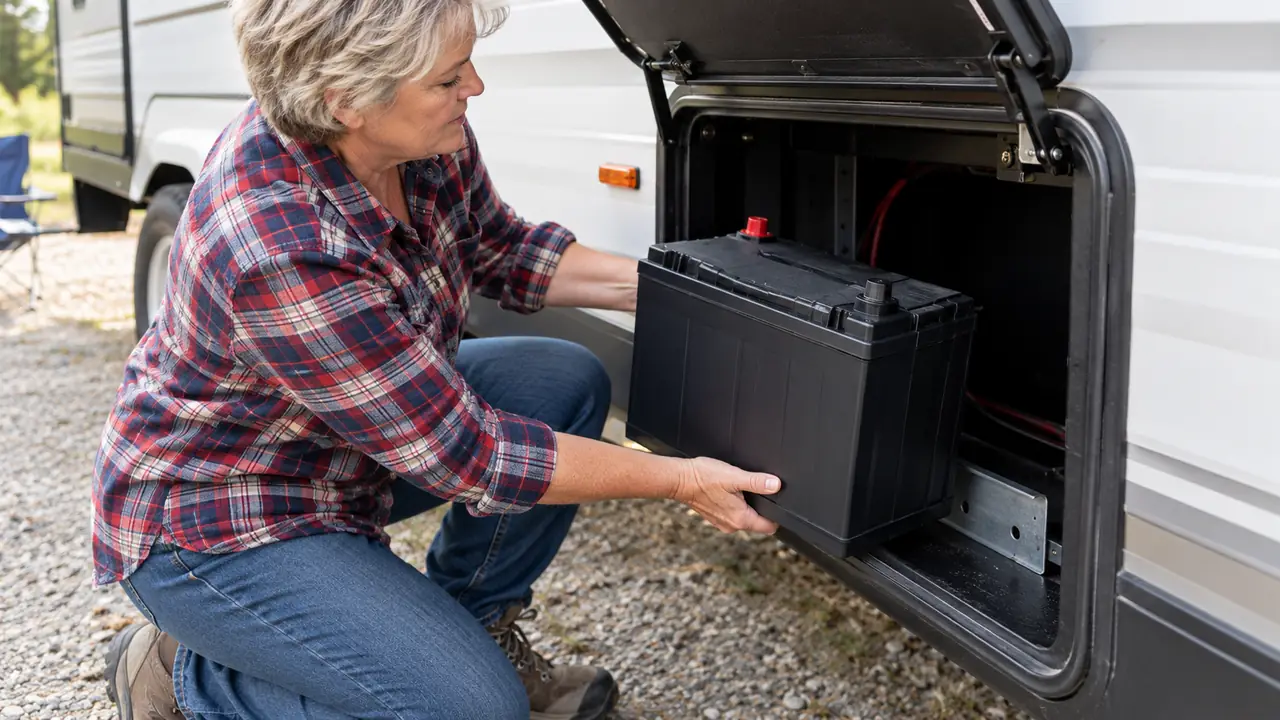
My setup is simple: one solar panel on the ground, a charge controller, and the battery in the trailer's front compartment. The Litime battery drops into the same space the AGM used. Because it is lighter, I can actually lift it out myself at the end of the season, which I could not say for the old battery.
On a typical weekend, the fridge is the biggest draw. It cycles on and off through the day, and the 12V fan runs for the dogs in the afternoon. At night, the lights and the phone charger add a little more. With the AGM, I was careful about how much I used after dark. With the Litime battery, I stop thinking about it. The voltage stays steady, and the BMS gives me a safety net if I push too far.
The one habit I changed: lithium batteries prefer not to be charged below freezing. I camp from late spring to mid fall, so this is rarely an issue for me. In the winter, the battery comes inside, which is easy at 22.1 pounds. If you leave a battery in a freezing trailer and charge it in the cold, pay attention to that limitation before you buy.
Where Litime Wins
The biggest win for me is usable capacity. An AGM deep cycle battery is rated in amp hours, but you do not want to run it down much past half if you want it to last. That turns a 100Ah AGM into roughly 50 usable amp hours in real camping. The Litime battery is rated 100 amp hours and the built-in 100A BMS protects it through over-discharge, so I can use far more of the battery before I need to think about charging. On a cloudy Saturday with the fridge cycling and the fan running for the dogs, that extra usable capacity is the difference between a comfortable weekend and a quiet one.
Weight is the second win you feel every single trip. The Litime battery weighs 22.1 pounds. The AGM it replaced felt like it weighed twice that, and my back noticed every time I pulled it out for the winter. The specs say the Litime is about a third of the weight of lead-acid, and that matches what I feel when I lift it. I also like the warranty: five years with 24-hour tech support. I have not needed it, but knowing it is there makes the upfront cost easier to swallow.
Where AGM Wins
I am not going to pretend AGM has no place. If you are building a system on a tight budget, the lower upfront cost of an AGM deep cycle battery is real money you can spend on a second solar panel or a better charger. That is a legitimate choice, and I have made it myself in the past. AGM also handles cold weather charging more gracefully than lithium. If your trailer sits in an unheated shed all winter and you charge in freezing temperatures, an AGM is the less fussy battery.
There is also a simplicity argument. An AGM battery does not need a battery management system to think about. You set your charger, you check the voltage now and then, and it just works. My first solar setup used an AGM battery and I did not have to learn anything about BMS cutoffs or low-temperature charging. For someone who wants the fewest possible things to learn before the first trip, that is a real advantage.
The battery I keep in my own trailer
After six years of camping with solar, the Litime 12V 100Ah LiFePO4 is the battery I trust for a weekend off-grid. It is lighter than the AGM it replaced, protects itself with a built-in 100A BMS, and carries a 5-year warranty.
Amazon Check Today's Price on Amazon →
The One Thing That Surprised Me
I expected the weight difference. I did not expect how steady the voltage seemed under load. With the AGM, the voltage would sag noticeably when I turned on something with a real draw, and the lights would dim for a second. The Litime battery seemed to hold voltage better under the same load. That steady voltage is what makes a small fridge and a fan feel like they are running on shore power.
The other surprise was how quickly it seemed to recover on a sunny morning. I do not have a meter to prove it, but the pattern was consistent across the season. The solar panel filled the battery well before lunch, which meant more usable power by evening. That is exactly what I want at camp.
What Nobody Tells You About AGM
The phrase 'deep cycle' makes an AGM sound like it is built to be drained. It is not. A deep cycle AGM can handle deeper discharge than a starting battery, but you still get the best life by stopping around half. That means a 100Ah AGM is really a 50Ah battery if you want it to last. Nobody told me that when I bought my first one.
The other thing nobody tells you is how much weight you carry for that capacity. A comparable AGM is often two or three times heavier than the Litime battery. In a 21-foot trailer, every pound matters, especially when you are lifting a battery out of a compartment by yourself at the end of the season. That is the kind of detail that does not show up in a spec sheet but shows up in your lower back.
A 100Ah AGM is really a 50Ah battery if you want it to last. That is the detail nobody tells you.
Alternatives I Considered
I looked at other lithium batteries before I settled on Litime. Some had Bluetooth monitoring, which sounded nice but was not something I needed. I wanted a simple, proven battery with a good warranty, and the Litime battery matched that. The specs list no Bluetooth version, and honestly, I did not miss it. I check voltage at the battery or through my charge controller, and that is enough.
I also considered staying with AGM and just buying a second battery for more capacity. That would have worked, but it meant more weight, more space, and more batteries to maintain. One Litime battery replaced the AGM, took less space, and weighed less than half as much. For my trailer, that was the simpler answer.
Who Should Buy Which
Buy the Litime battery if you camp off-grid for more than a night at a time, if you run a fridge, lights, and a small fan, and if you would rather lift 22.1 pounds than wrestle a lead-acid battery in and out of the trailer. Buy it if you want one battery to cover a decade of trips instead of budgeting for replacements.
Buy an AGM deep cycle battery if your budget is the deciding factor, if you mostly camp with hookups and only need a little reserve power, or if your battery sits in freezing storage and gets charged in the cold. There is nothing wrong with that choice. It is just a different set of trade-offs.
For my rig, the decision was already made. The Litime battery gives me the usable capacity, the weight, and the peace of mind I want when I am parked in a state park with no shore power and two dogs waiting for their fan.
Bottom Line
If you are building an off-grid camper and you plan to use it, the Litime 12V 100Ah LiFePO4 battery is the better long-term choice for most people. It is lighter, it gives you more usable capacity, and it is built to last 10+ years with up to 15,000+ cycles. The 5-year warranty and 24-hour tech support take the risk out of the higher upfront cost.
AGM is not a bad battery. It is a cheaper battery, and for some campers that is the right answer. But after a season with both in the same trailer, I know which one I am keeping. The Litime battery earns its place in my rig, and it is the one I recommend to anyone who asks about going off-grid.
Still deciding? Start with the battery, not the solar
The battery is the heart of an off-grid setup. The Litime 12V 100Ah LiFePO4 is the one I chose after killing an AGM with a cold night and a heavy draw. See the current price on Amazon and read the long-term review for the full story.
Amazon Check Today's Price on Amazon →