

The first time I woke up to a dead house battery in my 21-foot trailer, it was 42 degrees outside and the dogs were shivering under the blanket. I had a single 100W panel on the roof, a PWM controller, and a lot of faith. The faith ran out before the coffee did. That morning is the reason I started reading about MPPT charge controllers, and the reason I eventually landed on the Renogy Rover 40A.
An MPPT charge controller does more than pass power from your panel to your battery. It chases the best voltage, keeps the battery from cooking, and quietly makes a small solar setup feel twice as big. Here are ten reasons I think it matters for camper solar, in the order I learned them.
The charge controller that ended my cold-morning dread
I've run the Renogy Rover 40A in my trailer for three seasons now. It's the piece of my solar setup I'd replace last. Check today's price on Amazon and see if it fits your build.
Amazon Check Today's Price on Amazon →It turns a small panel into a harder-working one
A PWM controller pulls a panel down to battery voltage, which wastes the extra voltage a panel makes in cool weather. The Rover 40A tracks the panel's maximum power point and converts it down to what the battery can use. Renogy rates it for 98% conversion efficiency and 99% tracking efficiency, and on my 100W panel that difference shows up as a battery that's actually full by dinner. On a cloudy day, I can watch the LCD and see the controller still pulling something useful out of the panel. That's the kind of quiet gain you don't notice until you don't have it.
It handles 12V and 24V without a second thought
The Rover 40A auto-detects whether your system is 12V or 24V, so you don't have to remember to change a setting when you rewire. I run 12V in my trailer, but I've helped a friend wire a 24V system and the same controller works there without any fuss. That auto-detection is one less thing to get wrong, and one less thing to explain to a friend who borrows the trailer and pokes at the settings.
It keeps the battery safe when the temperature drops
Renogy says the Rover 40A operates from -40°F to 149°F and has built-in low-temperature protection. That matters in Vermont, where a cold snap can hit in late September. The controller won't push a charge into a battery that's too cold to take one safely. I've woken up to frost on the trailer windows and still had a battery that started the day without complaint. The protection is the reason I don't worry about the rig sitting for a week between trips.
It charges in stages, not all at once
The 4-stage MPPT charging routine is gentler than the one-size-fits-all charge my old controller pushed. My batteries are flooded, and the adjustable LCD lets me tell the controller exactly what I have so it charges that way. The stages matter because a battery that gets the right charge profile lasts longer, and a longer-lasting battery is the whole reason I switched to MPPT in the first place.
The LCD display ends the guessing
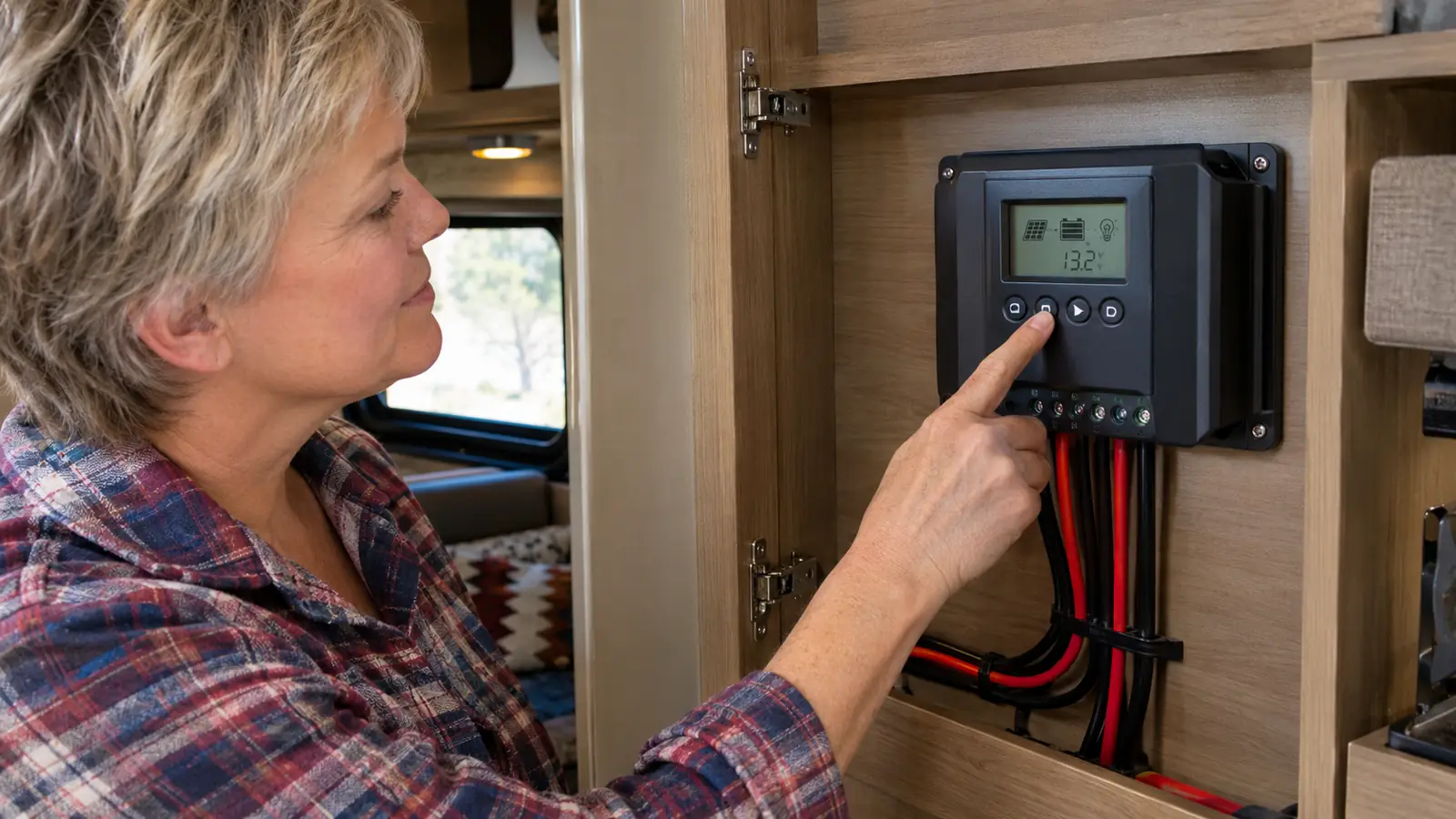
The built-in LCD display lets me see what the controller is doing, so I can tell whether the panel is actually making power on a cloudy day. The included remote temperature sensor gives the controller one more piece of information to work with. I'm a retired mechanic, so I like seeing actual readings instead of trusting a little green light. When I look at that display, I know exactly where my power stands.

It's built to live in a trailer
The aluminum housing and the all-weather design mean it doesn't mind the heat of a closed-up camper or the cold of an early spring night. The mounting brackets come in the box, so it's not another thing to buy. My trailer bounces down gravel roads all season, and the controller has never come loose or given me a flicker of trouble. That's what I want from something mounted to a wall.
You tell it what battery you have, once
Gel, sealed, flooded, or lithium, the adjustable LCD lets you set it and forget it. I set mine for flooded and the controller handles the rest, which is exactly the kind of set-and-forget I want from gear that lives behind a cabinet door. If I ever switch battery type, I can change the setting in a minute without rewiring anything. That flexibility is worth a lot when you're learning as you go.
It fits in a small space without a fuss
The Rover 40A measures 6.81 by 2.85 by 9.37 inches and weighs 1.1 kg, so it mounts flat against a wall or inside a cabinet. The included brackets make it easy to put it somewhere it won't get kicked. In a 21-foot trailer, space is the thing you never have enough of, and this controller tucks away without taking over the cabinet where I keep the dog food.
It comes with a warranty that means something
Renogy backs the Rover 40A with a 3-year material and workmanship warranty. When you're mounting something to a wall in a trailer that gets bounced down dirt roads, that matters. I've had gear fail after a season and had to eat the cost. Knowing the company stands behind this controller for three years makes it easier to trust the thing that keeps my fridge cold.
It makes a small setup feel bigger than it is
The real reason I care about MPPT is the peace of mind. With the Rover 40A, I run the small 12V fan for the dogs on warm afternoons, keep the fridge cold, and still wake up to a battery that's ready. That's the whole point of going solar in a camper. It's not about running a microwave or a TV. It's about having the basics covered and not thinking about the battery until you're ready to pack up.
What I'd Skip
If you only camp where there's shore power every night, an MPPT controller won't change much for you. If your whole setup is a single small panel trickle-charging a battery that never does real work, a 40A controller is more than you need. And if you don't like reading a manual, the Rover 40A has a learning curve. None of that makes it a bad controller. It just means it's not the right tool for every camper.
I'd also skip it if you're not ready to check your battery water. A flooded battery needs a look now and then, and the controller can't do that for you. But if you're willing to spend ten minutes a month on maintenance, the Rover 40A rewards you with a battery that lasts.
On a cool September morning, the Renogy Rover 40A had my flooded battery back to float by 10 a.m. on a single 100W panel.
Still on the fence? That's fair.
I wouldn't buy a 40A MPPT controller for every rig on the road. But for a 21-foot trailer with a real fridge and two dogs who need a fan on warm days, the Renogy Rover 40A earns its spot. See today's price on Amazon and decide for yourself.
Amazon Check Today's Price on Amazon →