

The first time I woke up to a dead house battery, it was 40 degrees, the dogs were shivering under the blanket, and the little 12V fan I run for them on warm afternoons was the last thing on my mind. I was just cold, and the furnace would not start. I stood there in my socks, staring at the Renogy charge controller mounted on the trailer wall, watching the LCD show a battery voltage that explained everything: I had been charging it, sure, but nowhere near enough.
That morning is the reason this story exists. I am Joanne, I have camped with solar for about six years now, and I have made most of the mistakes a person can make with a 12V system. I started with one small panel and a portable power station, blew a fuse on my second trip, and spent a lot of evenings reading forums by lantern light. Somewhere along the way I learned the difference between a controller that babysits a battery and one that actually finishes the job.
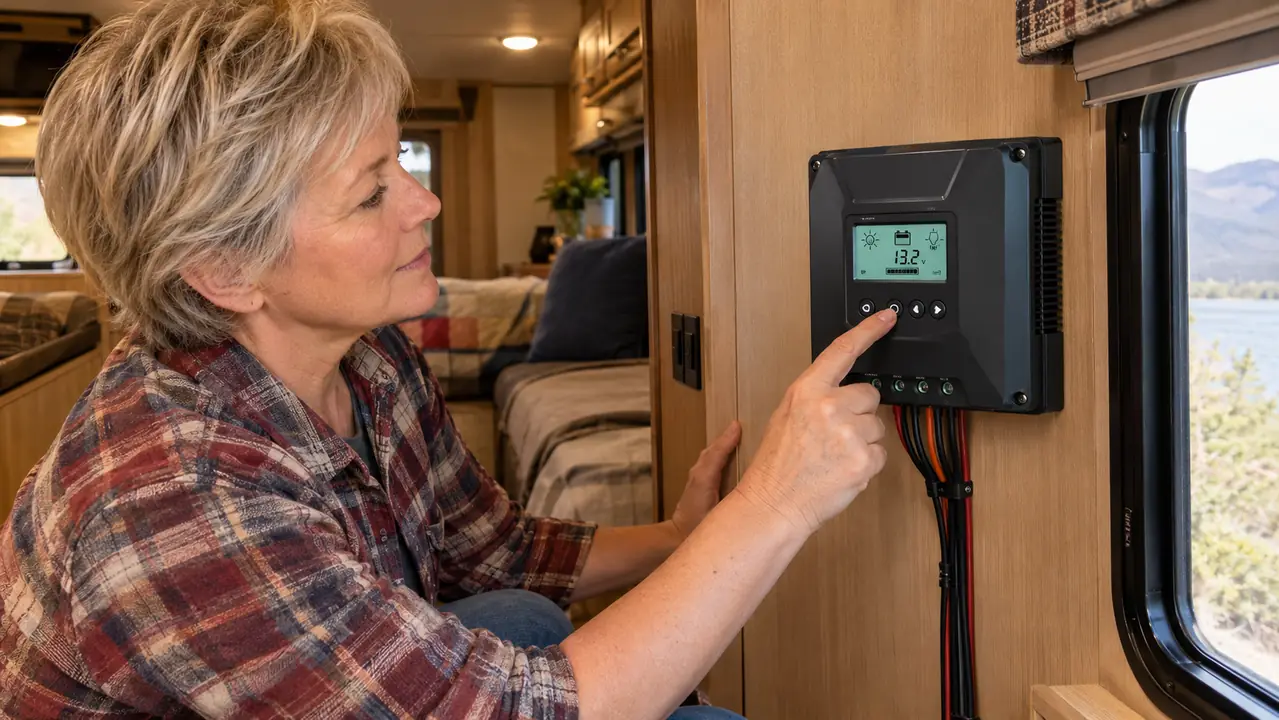
The Renogy Rover 40A MPPT is the second one. It is the little box that fixed my undercharged battery, and I want to tell you how it happened, because the fix was not a bigger panel or a second battery. It was a smarter middleman.
I swapped it in on a Tuesday in June, mostly because my old controller had started showing a voltage that made no sense, and I was tired of guessing. The Renogy Rover 40A MPPT is a 40A charge controller for 12V or 24V systems, and the first thing I noticed was the LCD. It shows you what is actually happening instead of making you do math in your head. I set it for the battery type, mounted the brackets, and went back to making coffee.
The battery did not need more sun. It needed a controller that would not waste the sun it already had.
Stop Guessing What Your Battery Is Doing
The Renogy Rover 40A MPPT shows you real charging data on its LCD, and it is built for the kind of weather a Vermont shoulder season throws at it. Check today's price on Amazon and see if it fits your setup.
Amazon Check Today's Price on Amazon →That first weekend with the Renogy Rover 40A MPPT, we camped at a state park with a canopy of maples between us and the sky. The old controller would have limped along, and I would have spent Sunday afternoon running the truck to charge the battery. Instead, the Renogy kept pulling in what little light came through the trees, and by Sunday morning the battery was sitting at a voltage I had not seen in months. I checked the LCD twice before I believed it.
I know part of that is MPPT technology. The Rover 40A is built to squeeze more usable power out of a panel than a simple PWM controller, and Renogy rates it at 98% conversion efficiency with 99% tracking efficiency. I am not an engineer, so I will put it in neighbor terms: it grabs more of what the panel is actually producing and turns it into battery charge instead of losing it as heat. On a cloudy day under those maples, that difference is the whole ballgame.

The other part is the four-stage charging. The Renogy Rover 40A MPPT uses a smart algorithm with 12V/24V auto-detection, and it adapts to the battery's state through a four-stage MPPT charging process. That means it does not just dump power in and hope. It works through the stages the battery actually needs, and it has built-in low-temperature protection for the cold nights I keep camping into. For someone who camps into late fall, that protection is not a footnote, it is the reason I can sleep.
It also came with a remote temperature sensor in the box, which I mounted near the battery bank. That little sensor is the sort of detail I would not have thought to buy separately, and it means the controller can account for the temperature of the batteries themselves instead of guessing from the air around it. The whole kit, including the four mounting brackets, took me about an hour to install on a Saturday morning.
What I'd Tell You If We Were Sitting at My Kitchen Table
If you were sitting at my kitchen table in central Vermont, I would pour you a cup of coffee and tell you this: before you buy a bigger panel or a second battery, look at the box in the middle. A good MPPT charge controller like the Renogy Rover 40A MPPT can get more out of the panel you already own, and that is a cheaper fix than buying more gear. I learned that the hard way, and I would rather you not repeat it.
I would also tell you to be honest about your battery type. The Renogy Rover 40A MPPT has adjustable LCD settings for gel, sealed, flooded, and lithium batteries, so it can match the charging profile to what you actually have. Set it once, check the LCD when you are setting up camp, and let it do its job. The less I fiddle with it, the better it works, which is exactly what I want from a piece of gear.
And I would tell you what I tell everyone who camps with dogs: steady power is not a luxury, it is how you keep everybody comfortable when the weather turns. The Renogy Rover 40A MPPT is the reason I stopped waking up to check voltage, and it is the reason the dogs sleep through the night on cold trips. That is worth more to me than any spec sheet. It is the difference between a good trip and a long one.
The Controller That Earned Its Spot in My Trailer
The Renogy Rover 40A MPPT has been mounted in my trailer since June, and it has not given me a single reason to second-guess it. If you are chasing an undercharged battery, this is a good place to start. Check today's price on Amazon.
Amazon Check Today's Price on Amazon →