
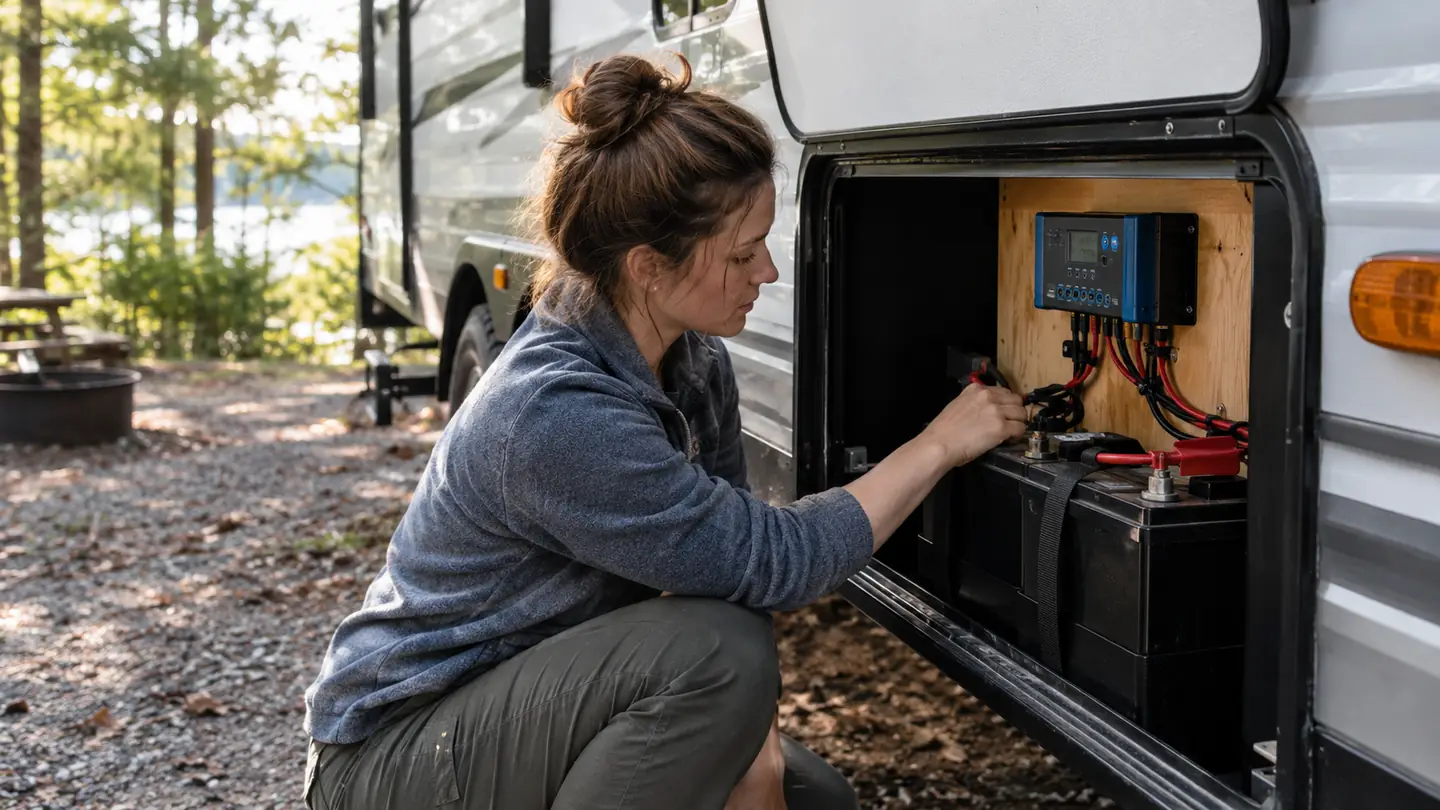
The night that made me switch happened in late September, three years into camping with solar. The sky had been grey all afternoon, my little fridge had been running since morning, and by nine o'clock the house battery was flat enough that the lights dimmed every time the fan kicked on. I sat there with a cold cup of coffee and a 12V fan blowing warm air at the dogs, wondering why a full day of sun had done so little. I dug out my multimeter and found the battery sitting at 12.1 volts, too low for the fridge to start reliably, even though the panel had been in full sun for most of the afternoon. The short answer was sitting right in my battery compartment: my old PWM charge controller was throwing away a good share of the panel's power. A few weeks later I replaced it with the Renogy Rover 40A MPPT charge controller, and the difference showed up on the first cloudy weekend. It was not the panels, and it was not the battery. It was the controller in between.
If you camp off-grid for more than a couple of nights at a time, the Renogy Rover 40A is the better fit for most trailers, and I will tell you why in plain language. A PWM controller is simpler and cheaper, and for a single small panel it may be all you need. But the moment you add a second panel, run a fridge, or camp where trees and clouds get between you and the sun, MPPT earns its higher cost back in power you actually get to use. The short version: if you are reading this because your battery keeps coming up short, you already know which way you are leaning. This comparison is about which one belongs in your rig, not about which one wins a spec sheet argument.
| Renogy Rover 40A MPPT | PWM Charge Controller | |
|---|---|---|
| Power in partial shade | MPPT tracking pulls more usable power when clouds or trees shade part of the array | PWM runs at battery voltage, so shade on any panel cuts output hard |
| Charging stages | 4-stage MPPT charging tuned to the battery type | Basic charging, often a single stage on budget units |
| Cold weather | Rated from -40°F to 149°F with built-in low-temp protection | No low-temp protection on typical budget PWM units |
| Battery types | Gel, sealed, flooded, and lithium with 12V/24V auto detection | Usually lead-acid only on inexpensive models |
| Ease of setup | More settings to learn, more wiring to do carefully | About as simple as a charge controller gets |
| Best for | Campers who run a fridge, a fan, and a small appliance daily | Weekenders with one panel and a small battery |
How I Compared Them
I ran the Renogy Rover 40A for a full season in my 21-foot 2016 travel trailer, towing it with my pickup truck to state parks and boondocking spots around Vermont. My setup is not fancy: a couple of panels on the roof, a 12V house battery, a small fridge, and a 12V fan for the dogs on warm afternoons. I cook most meals at camp, and I keep a low-wattage kitchen appliance or two for the days when I want something hot without firing up the stove. I also have a cat along on most trips, and the fan keeps the whole rig comfortable enough that nobody sulks in the heat.
Before the Rover, I had a PWM controller that came with my first solar kit, the kind you bolt on and forget. It worked, until it did not. On a cool October morning that first year, the battery voltage crawled up all day and still fell short by evening, and I did not understand why. I tried a bigger panel first, thinking the answer was more input, and that helped on sunny days but not on grey ones. That was the clue I needed. On cool, cloudy days the battery never got back to full, and on one cold night it dropped low enough that the fridge struggled to start. I read a lot about MPPT versus PWM before I spent the money, and most of what I found was written for people who already knew the difference. This comparison is the version I wish I had found back then, with the trade-offs spelled out instead of buried in efficiency curves.
Where the Renogy Rover 40A Wins
The biggest win is efficiency in real camping conditions. Renogy rates the Rover for a 98% conversion rate and 99% tracking efficiency, and while I cannot verify those numbers from a campsite, I can verify the behavior behind them. An MPPT controller adjusts the operating point of the panels so they deliver more power when the light is weak, the panels are warm, or part of the array is shaded. My old PWM controller simply pulled the panels down to battery voltage. That sounds fine until you realize how much of the panel's potential it wastes on a partly cloudy day in Vermont. The clearest proof came on a grey Saturday in late September, two weeks after I installed the Rover. Rain was spitting and the sky never opened up once, yet by late afternoon the battery had reached the float stage of its charge, a sight my old controller had almost never delivered before dinner. On a bright July day with the panels in full sun, the two controllers come much closer. The gap shows up when conditions get worse, and conditions always get worse eventually.
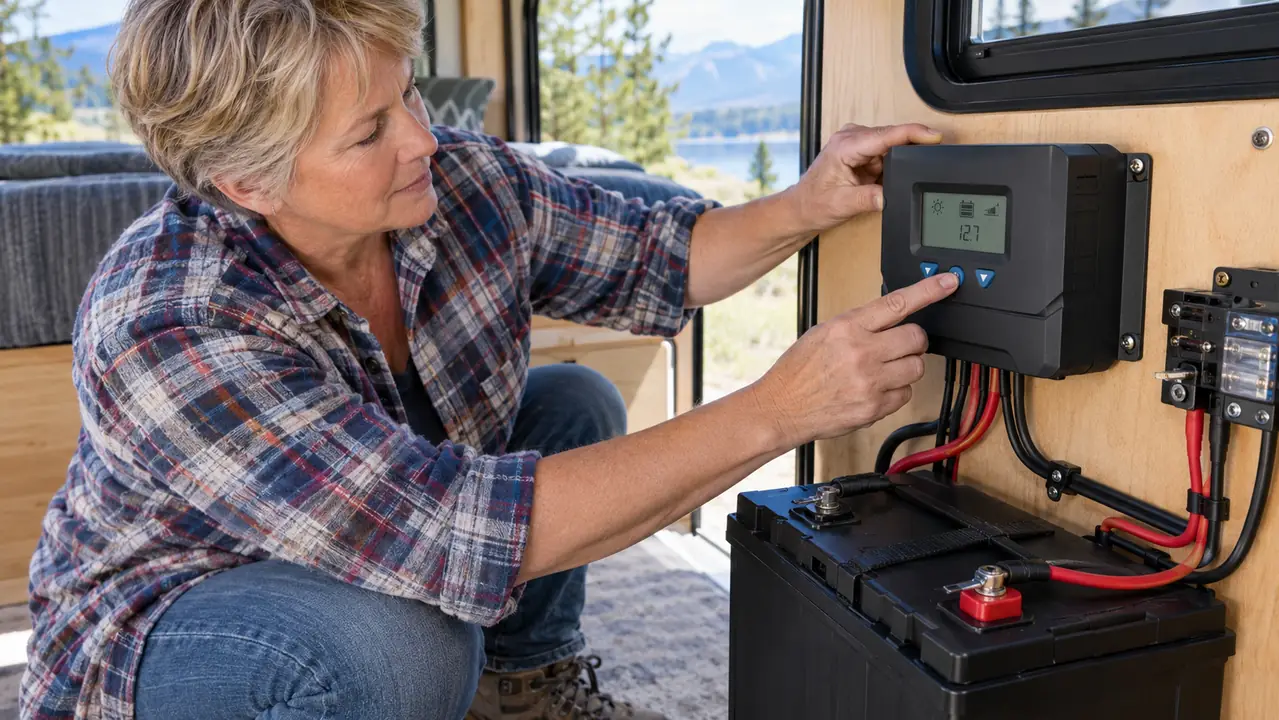
The other win is control. The Rover has an LCD display, 12V and 24V auto detection, and a 4-stage MPPT charging profile that can be set for gel, sealed, flooded, or lithium batteries. It also comes with a remote temperature sensor, mounting brackets, and a 3-year material and workmanship warranty, all in a 1.1 kg aluminum body that measures 6.81 by 2.85 by 9.37 inches. For someone who learned by blowing a fuse or two, being able to see what the controller is doing and set it for the battery I actually own is worth a lot. I know the battery is full because the display tells me, not because I crossed my fingers.
Where a PWM Controller Wins
A PWM controller wins on simplicity and up-front cost, and I do not want to wave that away. If you have one panel, a small battery, and you mostly camp where the sun is strong and the sky is open, a PWM controller will do the job for a fraction of the money. There is less to learn, less to wire, and less that can be set wrong. My first setup ran happily for two seasons before I outgrew it. I still keep a spare PWM controller in my toolbox for small projects around the property, and it does exactly what I ask of it. Last spring I used it to power a small pump at a garden shed with a single panel, and it has not given me a moment of trouble. That is a perfectly good tool for a perfectly good size of system, and recommending the Rover to someone who only needs that would be overselling.
PWM also wins if you never plan to grow. The Rover's extra capability only matters if you actually use it. If your power needs are a phone, a few lights, and a cooler that you ice up before you leave, the extra efficiency of MPPT is power you will never miss. I tell people to be honest about their camping style before they spend on a bigger controller. If your rig is small and your habits are light, the cheaper controller is not a compromise. It is the right call, and you can put the money you saved toward a better campsite.

What I'd Tell a Friend Wiring One Up
The Rover is not hard to install, but it is not a five-minute swap either. It comes with mounting brackets and a remote temperature sensor, and the adjustable LCD screen makes the setup menu fairly painless once you find it. I installed mine on a Saturday morning in May, and the whole job took about two hours, most of it spent routing the wires so nothing chafed against the trailer frame. I set the remote temperature sensor on the side of the battery box and wrote down every setting before I changed it, so I could put things back if I made a mistake. The part that takes patience is the wiring: making sure the solar input and the battery connections are both correct before you turn it on. I am a retired school bus mechanic, so I am comfortable with a wrench, but I still read the manual twice and checked every connection before I powered it up.
One thing nobody warned me about: the order matters. Connect the battery first, then the panels, and the controller walks through its startup sequence without complaint. I learned this the slow way on my first attempt, when I connected the panels first and the display would not settle down until I reversed the order and started over. If you connect it the other way, the display can behave oddly and you will spend an afternoon wondering what you did wrong. Plan where the remote temperature sensor will sit before you mount the controller, because it needs to read the battery, not the air around the controller. Those two details saved me a lot of head scratching, and they will save you the same.
What the Specs Don't Tell You
Reading the listing, the Rover sounds like a box of numbers: 40 amps, 98% conversion, 99% tracking efficiency, a temperature range from -40°F to 149°F. What the specs do not tell you is how it behaves when you are actually living in the rig. It runs quiet, it does not get hot enough to worry about on a summer afternoon, and it keeps the battery full even when the fridge cycles on and off all day. The morning that sold me was the first frost of the season, when the trailer sat overnight in 28 degrees and the battery still started the fridge without a groan. My old setup would have been sulking by then. The remote temperature sensor means the charging voltage adjusts as the battery warms and cools, which matters more than I expected for a battery that lives in an unheated trailer.
The other thing the specs do not tell you is how much easier it is to trust. With my old PWM controller, I was always doing mental math about whether the battery had recovered from the night before. With the Rover, I glance at the LCD and I know. That peace of mind is not on any spec sheet, but it is the reason I would buy it again. The aluminum body, the mounting brackets, and the clean wiring all feel like they were designed by someone who has actually camped.
The Controller That Fixed My Cold, Cloudy Nights
If your battery struggles on grey weekends, or you are adding a fridge and a fan to your rig, the Renogy Rover 40A MPPT is the controller I reached for. It handles 12V and 24V systems, reads the battery type, and keeps charging through weather that used to flatten my setup.
Amazon Check Today's Price on Amazon →Who Should Buy Which
Buy the Renogy Rover 40A MPPT if you camp off-grid for more than a night or two, run a fridge, keep a fan going for the dogs on warm afternoons, or park under trees on a regular basis. Buy it if you are adding a second panel, if your battery is lithium and you want charging set for that chemistry, or if you simply want to stop guessing whether your battery is actually full. I fit that description, and the Rover is the controller that ended my flat-battery nights.
Buy a PWM controller if your whole system is one small panel and one battery, if your power use is lights and charging devices, or if you want the least possible wiring and the lowest possible cost to get started. There is no shame in that choice. It is the same choice I made when I started with solar about six years ago, with a single small panel and a portable power station. The Rover is for when you outgrow that, and most off-grid campers do eventually.
If you are still torn, think about the weather where you camp. In the Northeast, where I spend most of my season, grey stretches are common enough that MPPT made an obvious difference for me. If you camp in the desert Southwest with wide open skies, the gap narrows and the cheaper controller looks smarter. Match the tool to your site, not to the marketing.
Still Deciding? Start With What You Actually Run
Make a list of everything you plug in at camp and count the cloudy days you really see. If that list includes a fridge, a fan, or a small appliance, the Renogy Rover 40A MPPT is the upgrade that pays for itself in usable power. If the list is short, save the money and keep it simple.
Amazon Check Today's Price on Amazon →