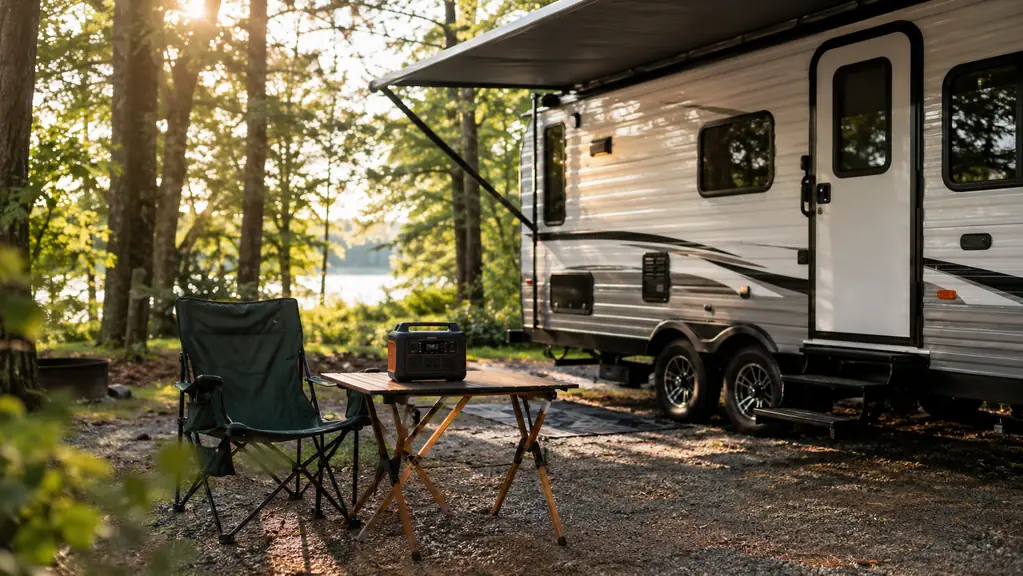
The first time I tried to camp with a phone and a fan, I blew the fuse on my trailer's 12-volt system and spent the night listening to the dogs pant. That was six years ago, before I learned the part that matters: you do not need a big solar setup to stay comfortable off grid. You need to know what you are plugging in, and you need a power station sized for the job. The Jackery Explorer 300 is the one I settled on, and this is exactly how I use it to charge phones and run the dogs' fan on every trip.
This is not a review with spec sheets and lab charts. It is a walkthrough from someone who camps in a 21-foot trailer in central Vermont, mostly in state parks and boondocking spots around the Northeast, and who needs two things to work every single day: my phone, because it is my map and my camera and my way to check the weather, and a small fan, because two dogs and a cat in a tin box get hot by three in the afternoon. Here is how I set it up, step by step, with the gear I actually use.
The exact power station I keep in my trailer
The Jackery Explorer 300 is the portable power station I reach for when I need to charge phones and run a fan with nothing to plug into. It weighs 7.1 pounds, it charges back up in about four hours, and it has been on every trip with me for the past two seasons.
Amazon Check Today's Price on Amazon →What You Need
The list is short. The Jackery Explorer 300, the charging cord it comes with, a USB-C cable for the phone, and the fan itself. If you are staying more than a weekend, add a folding solar panel and you are done. No wiring, no tools, nothing to bolt down. Everything plugs in and unplugs the same way it does at home.
Step 1: Add up what you actually want to run
Before you buy anything, sit at your kitchen table and make a list. Not a wish list of everything you might ever plug in. The short list of what you need on a normal camp day. For me that is a phone, charged once a day, and the dogs' little 12-volt fan, which runs for a few hours each warm afternoon.
Here is the math that matters. A phone takes roughly 10 to 15 watt-hours to charge from empty, depending on the phone. The fan draws somewhere in the range of 10 to 20 watts while it runs. Run the fan for four hours and you have used maybe 60 to 80 watt-hours. Add the phone and you are at about 90 watt-hours a day. If you are not sure what your fan draws, read the label on the back. Every fan and every charger has one, and the number on it is the one that matters.
Now compare that to the station. The Jackery Explorer 300 holds 292 watt-hours. Even on a heavy day, I am using less than a third of that. That is the whole trick: buy enough capacity for the normal day, not the fantasy day. You will carry less weight and spend less money.
Step 2: Pick a station that matches the load
The Explorer 300 is the size of a small toolbox, 9.1 by 5.2 by 7.8 inches, and it weighs 7.1 pounds. I can carry it in one hand from the trailer to the picnic table without thinking about it. That matters more than you expect, because the station moves around camp with you all day.
On the power side, it is rated for a maximum of 300 watts and it holds 292 watt-hours. That is plenty for a phone and a fan, and it leaves room for other small things: charging a tablet, topping up a camera battery, or running a strand of LED lights in the evening. The two AC outlets handle anything that needs a regular wall plug.
One thing I check before I plug anything in: the number on the label. Every charger and every fan has a sticker that says how many watts it draws. If the number is under 300, the Explorer 300 can run it. If it is over, this is not the station for that job. That simple check has saved me from every blown fuse I used to chase.
Step 3: Charge it before you leave
This is the step everyone gets wrong. They buy a power station, pack it, and show up at camp with a half-charged battery. The Jackery takes about four hours to charge fully from the wall using the charging cord it comes with. I plug it in the night before a trip, right next to my keys, so I cannot leave without it.
At camp, if I am staying more than a couple of days, I bring a folding solar panel and set it up in the morning sun. The Explorer 300 charges from a solar panel, and on a sunny afternoon it tops the station back up while I am out walking the dogs. I do not plan my day around it. I just lean the panel against the trailer, point it at the sun, and let it work. I have also learned to set the panel where the dogs cannot reach it, because a knocked-over panel is a cracked panel.
A note on the battery itself: the Explorer 300 uses LiFePO4 chemistry, which Jackery says is good for over 4,000 charge cycles. I do not baby this thing. I charge it, drain it, charge it again, and it has not shown any sign of slowing down.
Step 4: Plug in the phone and the fan
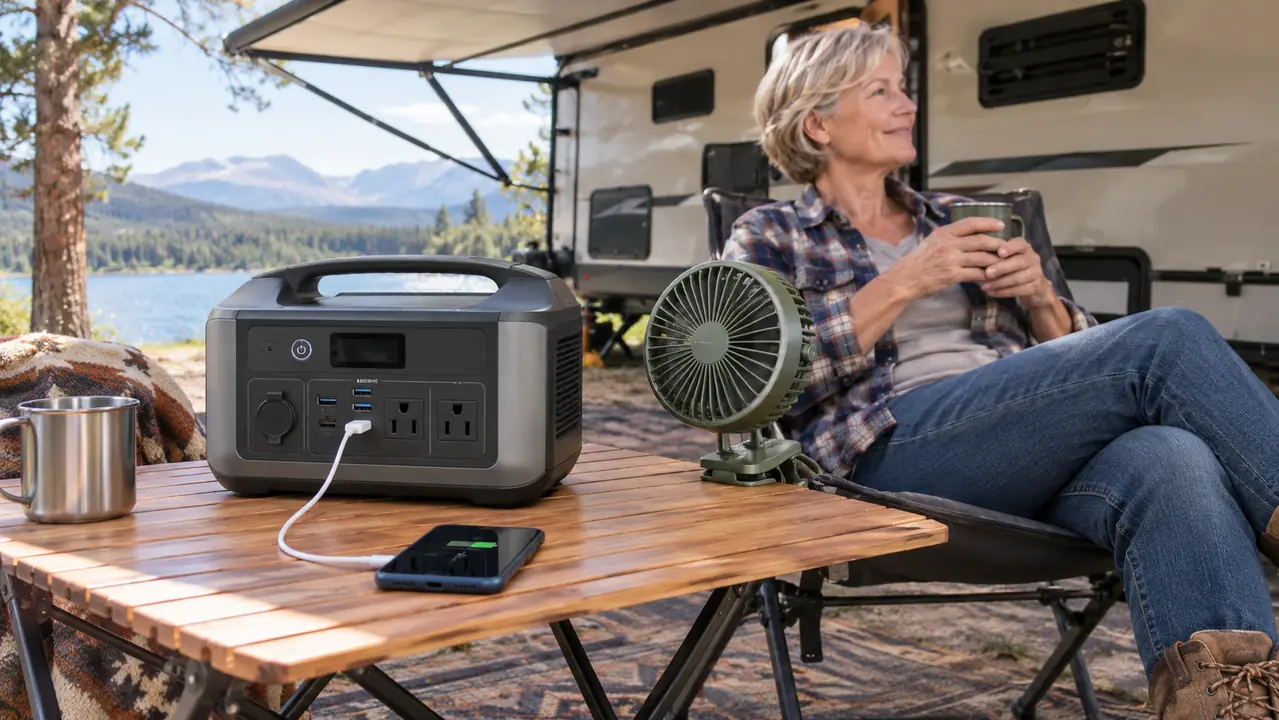
Here is the actual setup I run at camp. The phone goes into the USB-C port. The Explorer 300 has a 100-watt USB-C PD port, which is more than enough to fast-charge a modern phone, and it is the port I use every day. I plug the phone in when I sit down for breakfast and it is full by the time the coffee is done.
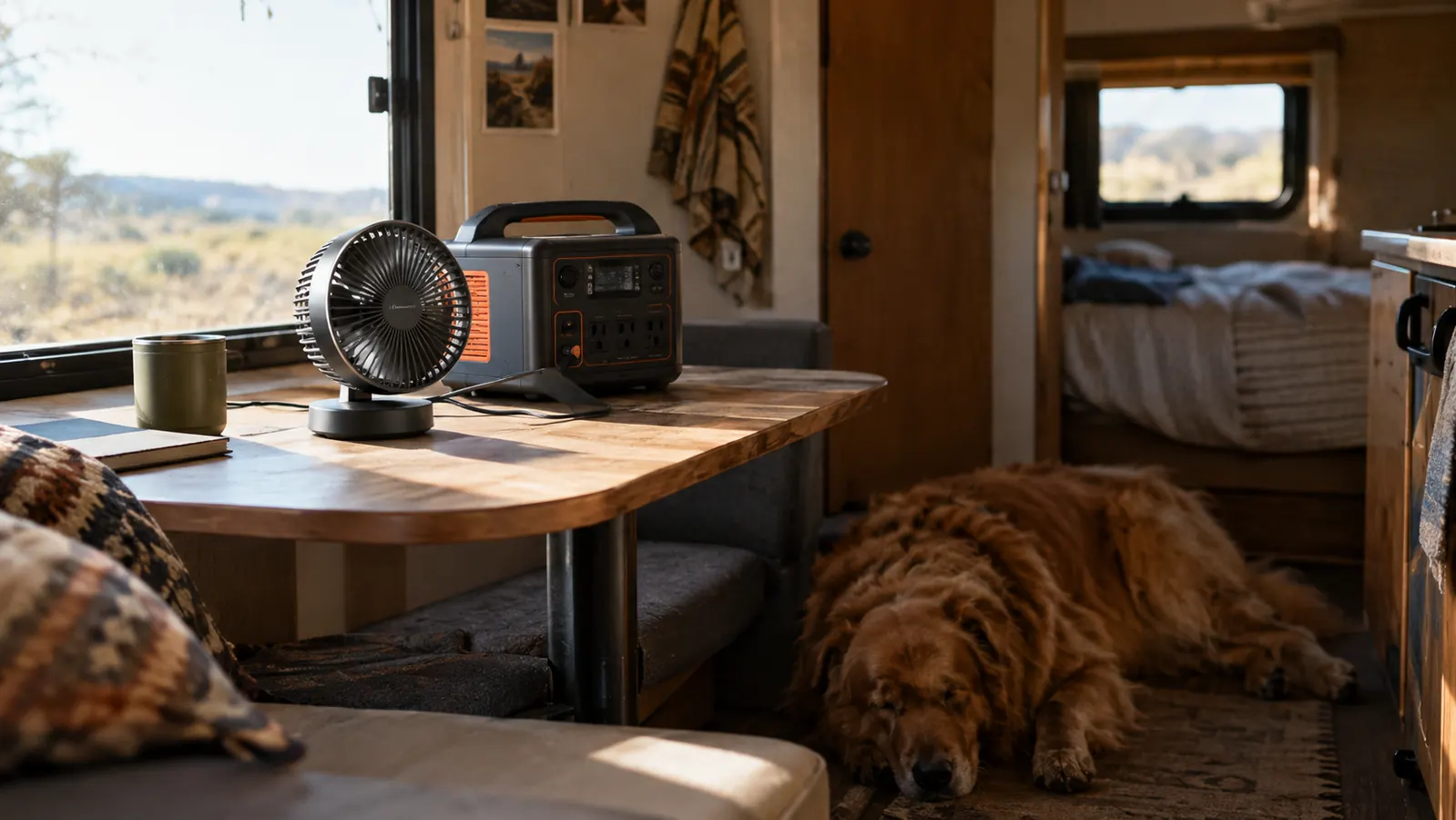
The dogs' fan plugs into the DC car port. It is a small 12-volt fan, and the car port is rated at 120 watts, so the fan barely makes a dent in the battery. On a warm afternoon I run it for a few hours while the dogs nap on the floor of the trailer. The cat claims the spot directly in front of it. On cooler days the fan stays in the bin and the station just charges the phone, which means I come home with most of the battery still in it.
If I need to charge something else at the same time, the two AC outlets are there for anything that takes a regular plug, and there are two USB-A ports as well. In practice, I rarely have more than two things going at once, and the station never breaks a sweat.
Step 5: Keep it topped up and make it last
The habit that keeps me from ever sitting with a dead phone is simple: I charge the phone in the morning and I run the fan in the afternoon. That routine uses well under half of the 292 watt-hours, so even on a cloudy stretch I am never close to the bottom. On the rare days I use more, I just plug in a little less the next day.
On longer trips, I charge the station back up mid-week. From the wall it takes about four hours. From the solar panel it takes however long the sun gives me, which is why I set the panel up early and leave it out all day. I would rather come home with the station half full than leave camp with it empty.
One more thing: the Explorer 300 is rated for roughly five hours of runtime, and I treat that as the floor, not the ceiling. Because I am only drawing 20 or 30 watts at a time, I get far more than five hours out of a charge. The rating assumes a heavy load. My load is light.
Mistakes I Made So You Do Not Have To
The first mistake was buying a station that was too small. I started with a little unit that could charge a phone but not much else, and I ran it dead by noon on the second day. The second mistake was the opposite: I almost talked myself into a much bigger station that I would have hauled around for no reason. The Explorer 300 sits in the middle, and for phones and a fan, the middle is exactly right.
The third mistake was leaving the station at home on a short trip. I figured I would be in a state park with hookups, so why bother. Then the campground lost power for an evening and my phone was at 15 percent with no way to charge it. Now the Jackery rides in the truck on every trip, even the ones where I expect to plug in.
What Else Helps
A small folding solar panel is the single best addition to this setup. I started with one small panel and a portable power station six years ago, and that is still the core of how I camp. A longer USB-C cable helps too, so the station can stay on the counter while the phone sleeps on the bed beside me. And a cheap 12-volt extension, if your fan has a plug that does not quite reach, saves you from rearranging the whole trailer.
And one thing I stopped bothering with: a big inverter. I used to think I needed to run anything I could at home. The truth is, I camp to get away from all that. A phone and a fan cover the real needs, and the station covers the rest.
When 300 Watts Is Not Enough
If you want to run a microwave, a space heater, or anything with a heating element, the Explorer 300 is not the station for you. That is not a knock on it. It is a 300-watt station with 292 watt-hours, and it is honest about what it is. For my camping, which is phones, a fan, a tablet and lights, it is more than enough. For bigger loads, you would want a larger station, and that is a different conversation.
I have run my phone and the dogs' fan off this little station for two seasons now, and I have never once been stuck with a dead battery at camp.
That is the whole system. No wiring into the trailer, no inverter, no second battery under the bed. If you are on the fence, start with the station and a phone cable, camp one weekend, and see what you actually use. That is how I built my setup, and it is the easiest way to build yours. And if you already own a different power station, the steps are the same. The numbers change, the habit does not.
Start your off-grid setup with the Explorer 300
If you are new to solar and just want to charge phones and run a small fan without the trailer plugged into anything, this is the station I would buy again tomorrow. It is light enough to carry, simple enough to ignore, and big enough for the days that matter.
Amazon Check Today's Price on Amazon →