
I will start with the part that nobody puts on the box: a charge controller will not fix a solar setup that is undersized, and it will not rescue a battery that is already cooked. I learned that the expensive way two winters ago, and it is the reason I am writing this review at all. The Renogy Rover 40A MPPT Controller is a good piece of equipment. It is not magic, and the people who talk about it like it is magic are usually selling something.
I am Joanne, I am 58, and I have spent the last six seasons camping in a 21-foot travel trailer around Vermont and the Northeast. I run a small 12V fan for the dogs on warm afternoons, I cook most meals at camp, and I keep a small fridge going off-grid. My first setup was a single panel and a portable power station, and I blew through more than one battery before I understood what I was doing. The Renogy Rover 40A has been on the wall of my trailer for two full seasons now, roughly 60 nights off-grid, and this is the review I wish someone had handed me before I bought it.
The Quick Verdict
A genuinely good MPPT controller for a 12V trailer setup, with a readable LCD and a remote temperature sensor in the box. It is not the controller for a tiny weekend panel, and it is not the controller for someone who will never read the manual.
Amazon Check Today's Price →The controller that finally stopped my battery anxiety
After two seasons, the Renogy Rover 40A is the piece of my solar setup I trust the most. If you are building or upgrading a 12V trailer system, check today's price on Amazon.
Amazon Check Today's Price on Amazon →How I've Used It
The Rover 40A sits between my two 100W panels and my 12V house battery. That is a modest setup by most standards, and honestly, a 40A controller is more than those panels will ever ask for. I bought it on purpose, because I planned to grow the array, and I did not want to replace the controller again when I did. Two seasons in, that decision has held up.
What I actually run: the small fridge, LED lights, the 12V fan for the dogs, a phone and a tablet, and occasionally a low-wattage kitchen appliance for one meal. I am not running a microwave or a coffee maker off this system, and I do not pretend otherwise. The fridge pulls more than anything else, especially in the late afternoon when the compressor kicks on after I have opened the door a few times. The fan for the dogs draws almost nothing, but it runs for hours on warm afternoons, and it is the reason I care about steady power at all. On a hot July day I can watch the voltage on the LCD dip and recover as the fan cycles, and knowing that dip is normal is half the battle. I keep a notebook in the trailer and jot down the voltage each morning, and the pattern has been boring in the best way: full battery by mid-morning on sunny days, and only the truly awful stretches leave it short. The controller's job is to take whatever the panels are producing and turn it into battery charge as efficiently as it can. On that job, the Renogy Rover has been steady.
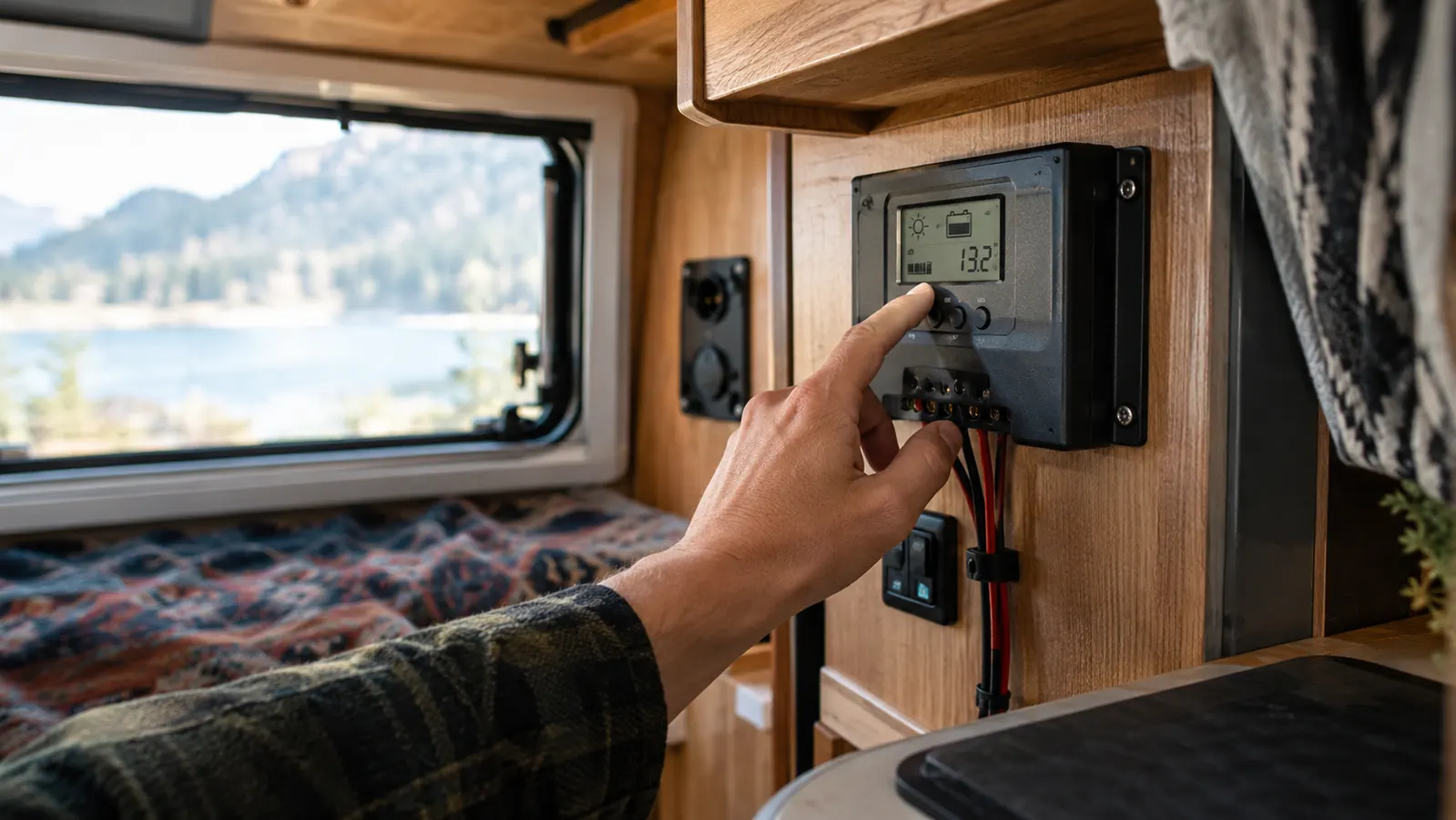
The first thing you notice is the LCD. It is bright enough to read in full sun, which matters more than you think when you are crouched in a campground trying to figure out why your battery is low. The display shows voltage and charging status without needing a phone app or a separate screen. For someone like me, who likes to understand what the equipment is doing, that alone is worth a lot.
I should also say what the LCD does not show you. It gives voltage and charging status, but it will not tell you how many amp-hours you pulled out of the battery last night, and it will not warn you that your fridge compressor is about to kick on. I learned that lesson on a cool June night at a state park in New Hampshire, when I woke up to a battery at 11.9V and a fridge that had stopped hours earlier. The controller did exactly what it was supposed to do. The problem was that I had asked a 40A controller to make up for a panel array that was too small for a cloudy day. It could not, and no controller on the market could have.
The Setup That Nobody Warns You About
Here is what nobody tells you before you buy: this controller expects you to read the manual. The Renogy Rover 40A is not a plug-and-play gadget. It is a real piece of electrical equipment, and it arrives with mounting brackets, a remote temperature sensor, and a small list of decisions you have to make before you wire it in.
The controller auto-detects 12V or 24V systems, which is genuinely useful. But you still have to choose your battery type from the LCD menu: gel, sealed, flooded, or lithium. That choice changes how the controller charges, and it is not the kind of setting you want to guess. I have a flooded battery, and I set it to flooded and left it alone. I will tell you what happened when I first got mine: I skimmed the manual, picked the wrong setting, and spent a whole afternoon convinced the controller was broken because the voltage read higher than the battery was actually holding. It was not broken. I had told it to charge a battery the way you charge a different kind of battery, and it obediently did what I asked. If you change battery types later, you have to go back into that menu and change the setting to match. Write it on a piece of tape and stick it near the controller, because you will not remember in October what you set in May.
I also want to be honest about the wiring. The terminals are solid, but they are not huge, and if you have thick battery cable, you will spend some time getting everything seated properly. The included remote temperature sensor is a nice touch, and it is the part I did not expect to care about. On a cold Vermont night, knowing the controller is adjusting for battery temperature instead of guessing is a real comfort.
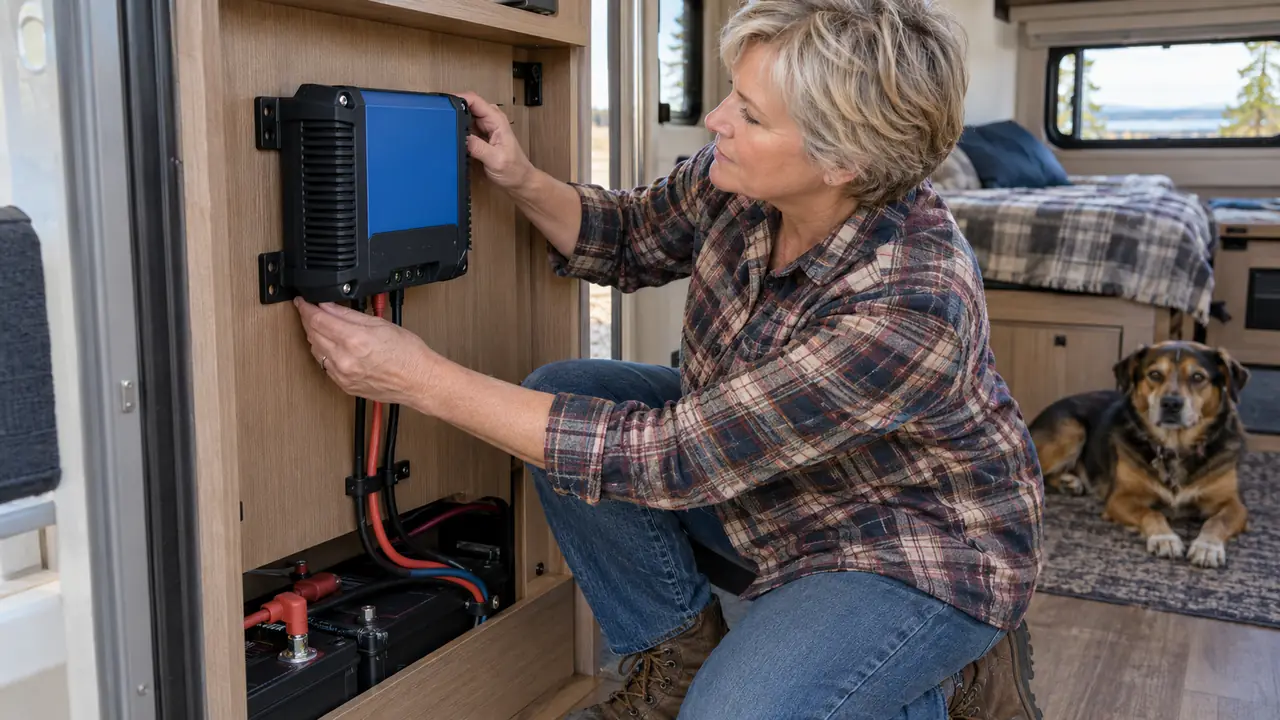
My first attempt at installing it took most of a rainy afternoon, and I will tell you exactly where I went wrong. I mounted the controller first and then tried to route the battery cables up to it, which meant working blind behind the aluminum case with barely enough room for my fingers. The second time, on a friend's trailer, I did it in the sensible order: I ran and labeled the cables first, mounted the brackets second, and connected the controller last. It took maybe forty minutes. The manual does not tell you that, and it should.
What It Does Well
The Renogy Rover 40A's real strength is that it is an MPPT controller, not a PWM one. Without getting too deep into the weeds, MPPT is better at pulling usable power out of a panel when conditions are not perfect: partial shade, cloudy days, morning and evening light. I have camped under trees more times than I can count, and the difference between this controller and my old PWM one is noticeable.
Renogy lists a 98% conversion rate and 99% tracking efficiency for the MPPT technology in this controller. I cannot verify those numbers from my campsite, and I would be suspicious of anyone who says they can. What I can tell you is the practical result: my battery gets to full more often, and it gets there faster, than it did with the cheaper controller I started with.
The build quality is also worth naming. The aluminum case feels substantial, and the controller has survived two seasons of trailer life, including one very damp stretch in Maine. It operates in temperatures from -40°F to 149°F, which covers every trip I have ever taken and then some. For a piece of equipment that lives on a wall and gets ignored for months at a time, it has been remarkably dependable.
Let me give you a specific day. Last October I was parked in a state forest in central Vermont under a heavy overcast that did not lift for three days. The date was the fourteenth, and I remember it because I wrote it in the notebook I keep in the trailer. The first morning the sky was the color of a wet wool blanket, and the panels were putting out barely enough to cover the fridge. My old PWM controller would have left the battery hovering around 12.4V by the second afternoon, and I would have been rationing the fan and the lights. With the Rover, the battery climbed back to a comfortable 12.7V by the middle of the third day, even with the fridge running and the dogs dozing on their mat while the rain tapped the roof. I checked the LCD every few hours like it was a campfire, and the number just sat there, steady. Three days of overcast used to mean three days of watching the voltage fall and doing nothing useful about it. Now it just means the controller is quietly doing its job while I make coffee and read. That is the difference I can actually measure from where I sit: not a lab number, but a battery that holds its own through weather I used to dread.
The real difference between this MPPT controller and my old PWM one showed up on cloudy afternoons: the battery got to full more often, and it got there faster.

The Quirks I've Learned to Live With
Now the honest part. The Renogy Rover 40A has quirks, and you should know about them before you buy.
First, the LCD is informative but not exactly intuitive. The menu system takes a little poking around before it makes sense. I am a retired school bus mechanic, so I am comfortable with buttons and menus. My neighbor, who is a perfectly smart person, handed me the controller once and asked why there were so many screens. She is not wrong. Plan for an afternoon with the manual.
Second, the controller is bigger than the photos suggest. The dimensions are 6.81 inches long, 2.85 inches wide, and 9.37 inches high, and it weighs 1.1 kg. That is not a problem once it is mounted, but if you are squeezing it into a tiny cabinet next to your battery, measure the space first. I mounted mine on an open wall, which is the right call if you have the room.
Third, and this is the one that surprised me: the Renogy Rover 40A is almost too capable for a small setup. If you are running a single suitcase panel and a portable power station, this controller is overkill. It is built for a real system, with real battery banks and room to grow. That is not a criticism of the controller. It is a warning about matching the tool to the job.
There is one more thing I want to flag, because it cost me a half hour of confusion on my first trip. The LCD shows the battery voltage in a big, easy-to-read number, and it is natural to assume that number is the whole story. It is not. The controller is also deciding between charging modes in the background, and the voltage you see depends on what the battery is doing at that exact moment. A battery that reads 13.6V while charging can settle to 12.8V an hour after the panels go dark. That is normal behavior, not a fault, but nobody tells you that either. I remember the first trip with this controller, a Thursday evening at a private campground in southern Vermont. The sun had been down for an hour, the display still said 13.6V, and I sat there convinced the controller was stuck in a charge mode it should have left. I finally called a friend who knows more about solar than I do, and she laughed and told me to go make dinner and check it again in the morning. It read 12.8V, exactly where it belonged. I spent that whole evening convinced something was wrong, and the only thing wrong was my understanding of what the number meant. Now I read the LCD twice a day, morning and evening, and I compare the two numbers instead of panicking about either one.
What I Liked
- Genuine MPPT charging that shows its worth on cloudy days and under trees
- Readable LCD with voltage and charging status, no phone app required
- Remote temperature sensor included, and it matters more than you expect
- Aluminum case that has survived two seasons of trailer life without a complaint
- 12V/24V auto-detection plus a 4-stage charging algorithm for the battery type you pick
- Room to grow: a 40A controller still makes sense when you add a third panel
Where It Falls Short
- The menu system is not intuitive, and the manual is not optional reading
- Terminals are solid but not huge, so thick battery cable needs patience
- Bigger than the photos suggest, at 6.81 by 2.85 by 9.37 inches
- Overkill for a single small panel or a portable power station
- The LCD will not tell you how many amp-hours you used, so you still have to do some math yourself
Who This Is For
The Renogy Rover 40A is for the camper who is done guessing. If you have a 12V house battery, you are adding panels over time, and you want a controller that will still be the right choice when you add a third panel, this is a strong candidate. It is also for the person who wants to understand their system: the LCD gives you real information, and the battery type menu forces you to learn what kind of battery you actually have. That is a feature, not a bug.
It is also for the person who camps in the shoulder seasons, like I do. The controller is rated to operate from -40°F to 149°F, and the remote temperature sensor means it adjusts charging for the battery's temperature instead of assuming a warm summer day. My season runs from late spring to mid fall, and I have camped in frost more than once. Knowing the controller is thinking about temperature is one less thing I worry about when the nights get cold.
Who Should Skip It
Skip the Renogy Rover 40A if you just want to plug in a small panel and go. A simpler PWM controller will do that job for less money and less fuss. Skip it if you are not willing to read the manual, because this controller will not do your thinking for you. And skip it if you have a 24V system and no plans to ever touch the settings, because the auto-detection is clever but the battery type menu still requires a decision.
I would also tell a weekend camper who runs one portable panel and a power bank to skip it. The Rover 40A is built for a real house battery and a system that grows over time. If that is not you, you will be paying for capability you never use, and you will be reading a manual you did not want. There is no shame in that. Matching the controller to the job is the whole game, and the Rover's job is bigger than a weekend setup.
Ready to stop watching your battery gauge drop?
Two seasons in, the Renogy Rover 40A is the piece of my solar setup I would replace first if it failed. If you are building or upgrading a 12V trailer system, check today's price on Amazon.
Amazon Check Today's Price on Amazon →